Close Menu
    Facebook LinkedIn
    Geo365
    Facebook LinkedIn
    BESTILL Login ABONNÉR PÅ NYHETSBREV
    • Hjem
    • Anlegg og infrastruktur
    • Aktuelt
    • Bergindustri
    • Dyphavsmineraler
    • Miljø
    • Olje og gass
    • Geofunn
    • Download Media Guide
    Geo365
    You are at:Home » Gnomoria appraisal success via seismic inversion and sound depositional modelling
    Olje og gass

    Gnomoria appraisal success via seismic inversion and sound depositional modelling

    The Gnomoria discovery in the Norwegian North Sea is a great example of how seismic inversion helps to identify reservoir sweet spots.
    By Henk Kombrinkoktober 7, 2025
    Del denne artikkelen Facebook Twitter LinkedIn Email

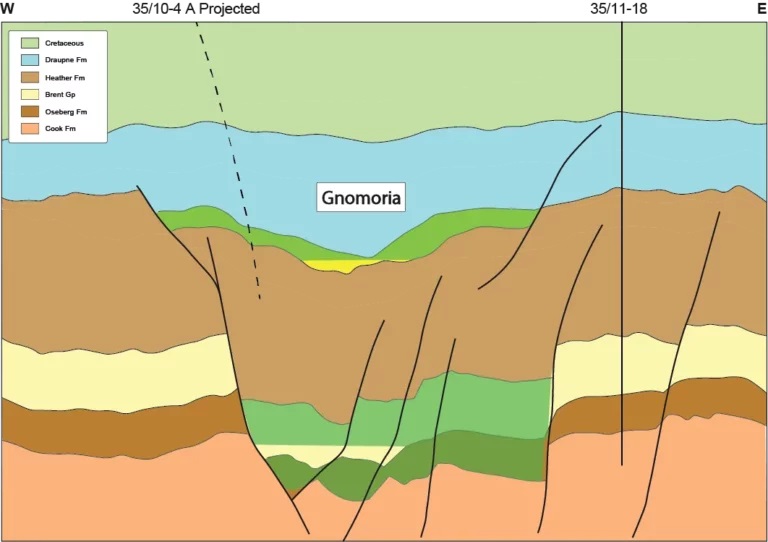
    The Gnomoria prospect, as illustrated prior to drilling the discovery well. Source: Wellesley Petroleum

    Facebook Twitter LinkedIn Email

    This story was first published on GEO EXPRO.

    Let’s take a step back and look at the structures targeted in the early days of North Sea exploration. It is no surprise that back then, the big fields were found first, as the seismic data was rudimentary and only really lent itself to identifying the major traps.

    Fast forward to today, and the way seismic data is used to better understand the subsurface is remarkable. Subtle traps can now be explored and, even better, reservoir heterogeneity within the closure itself. It is that latter aspect that has allowed Wellesley and partner Equinor to turn an initially uneconomic discovery into an economic one. Here’s how.

    The Gnomoria discovery was made in 2018 through drilling well 35/10-4 A. It found an Upper Jurassic succession of turbidite deposits associated with a delta system positioned to the southeast. However, the targeted sand proved too fine-grained and was cemented, even though oil shows were reported. The conclusion at the time was that if a more porous reservoir could be found, the discovery might work. That’s where new seismic inversion data came in.

    Aided by surrounding offset wells drilled since the initial Gnomoria discovery well, and using Viridien’s latest shoot over the North of Troll area, a team from Qeye performed a full elastic and direct probabilistic inversion exercise across the discovery in an attempt to better predict the spatial distribution of the different facies in the interval of interest.

    One of the main outcomes was that the 35/10-4 A well was drilled in a location where the inversion predicted non-productive reservoir. However, all around the well, the probability of finding productive reservoir turned out to be greater than 60%, making a clear case to drill an appraisal well.
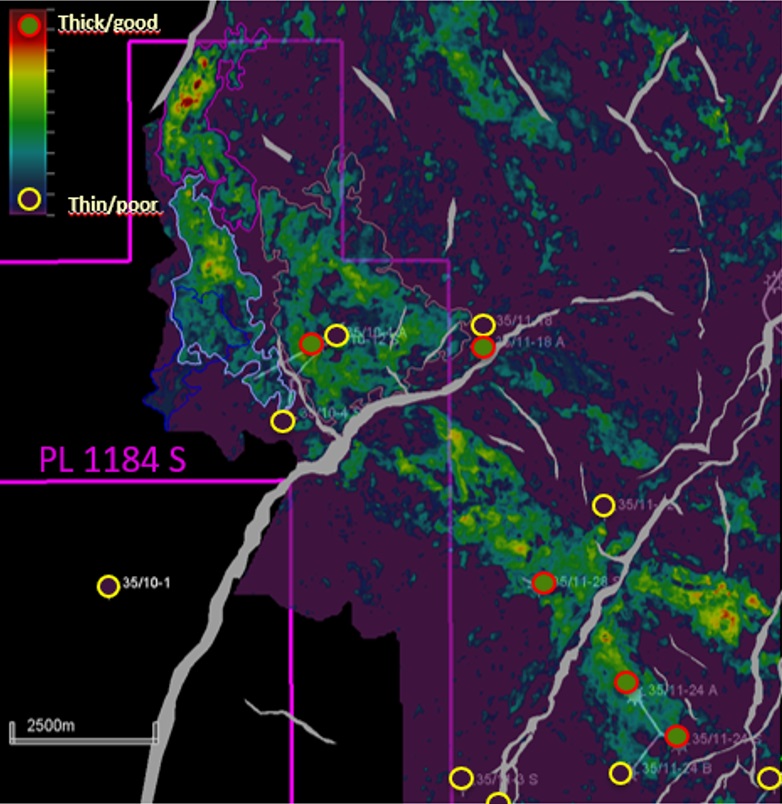
    Probabilistic inversion result of the main reservoir interval in Gnomoria, showing the poor quality in the area of the discovery well and the predicted – and proven – enhanced quality a little further to the west. Seismic data courtesy of Viridien, analysis performed by Qeye.

    Before making a call on that, the team first wanted to better understand why the reservoir in the discovery well was so fine-grained, also compared to offset wells. After a careful mapping exercise, the most logical explanation seemed to be compensational stacking, with the poor section in 35/10-4 A being deposited in an area where the underlying turbidite sand was well developed, blocky and thick. This created a more unconfined environment for the subsequent sand input, resulting in a poorer and finer-grained nature than the surrounding and more confined areas of flow. This allowed the team, together with the seismic inversion results, to take the decision to appraise the discovery. The results confirmed predictions.

    35/10-12 S did indeed find more net reservoir than the discovery well, in line with a less well-developed underlying sand. A 21 m hydrocarbon column was proven, with an average porosity of around 12%. The expected volume range for Gnomoria now stands between 5 and 25 MMboe.

    Related Posts

    Betydelig funn i Sleipner-området

    desember 5, 2025

    Agents with alibis

    desember 3, 2025

    AI-powered production monitoring

    desember 3, 2025
    Add A Comment

    Comments are closed.

    NYHETSBREV
    Abonner på vårt nyhetsbrev
    geo365.no: ledende leverandør av nyheter og kunnskap som vedrører geofaget og geofaglige problemstillinger relatert til norsk samfunnsliv og næringsliv.
    KONFERANSER

    Rock-Eval, geokjemi og misforståelser
    Dec 16, 2025

    Rock-Eval, geokjemi og misforståelser

    Første kobber fra det norske dyphavet
    Dec 15, 2025

    Første kobber fra det norske dyphavet

    Kommer: GEO 2026 og Geokalenderen 
    Dec 12, 2025

    Kommer: GEO 2026 og Geokalenderen 

    Samlet seismikk nord for Svalbard
    Dec 12, 2025

    Samlet seismikk nord for Svalbard

    Gull: Etiopia
    Dec 08, 2025

    Gull: Etiopia

    It’s time to introduce chromostratigraphy
    Dec 16, 2025

    It’s time to introduce chromostratigraphy

    Hydrocarbon and seal properties are key
    Dec 15, 2025

    Hydrocarbon and seal properties are key

    The Gambia’s offshore acreage is hot again
    Dec 12, 2025

    The Gambia’s offshore acreage is hot again

    “FWI has changed the game”
    Dec 11, 2025

    “FWI has changed the game”

    A “monumental deposit” or an attempt to revive coal-seam gas exploitation?
    Dec 10, 2025

    A “monumental deposit” or an attempt to revive coal-seam gas exploitation?

    OLJEPRIS
    BCOUSD quotes by TradingView
    GULLPRIS
    GOLD quotes by TradingView
    KOBBERPRIS
    Track all markets on TradingView
    GeoPublishing AS

    GeoPublishing AS
    Trollkleiva 23
    N-1389 Heggedal

    Publisher & General Manager

    Ingvild Ryggen Carstens
    ingvild@geopublishing.no
    cell: +47 974 69 090

    Editor in Chief

    Ronny Setså
    ronny@geopublishing.no
    +47 901 08 659

    Media Guide

    Download Media Guide

    ABONNEMENT
    NYHETSBREV
    Abonner på vårt nyhetsbrev
    © 2025 GeoPublishing AS - All rights reserved.

    Type above and press Enter to search. Press Esc to cancel.