Close Menu
    Facebook LinkedIn
    Geo365
    Facebook LinkedIn
    BESTILL Login ABONNÉR PÅ NYHETSBREV
    • Hjem
    • Anlegg og infrastruktur
    • Aktuelt
    • Bergindustri
    • Dyphavsmineraler
    • Miljø
    • Olje og gass
    • Geofunn
    • Download Media Guide
    Geo365
    You are at:Home » Zero-waste processing of deep-sea minerals
    Dyphavsmineraler

    Zero-waste processing of deep-sea minerals

    At Seabed Minerals 2026, Professor Markus Bertau of TU Bergakademie Freiberg will present an economic assessment of new hydrometallurgical processing routes for deep-sea minerals that could enable low-emission, zero-solid-waste metal production.
    By Redaksjonenmars 19, 2026
    Del denne artikkelen Facebook Twitter LinkedIn Email

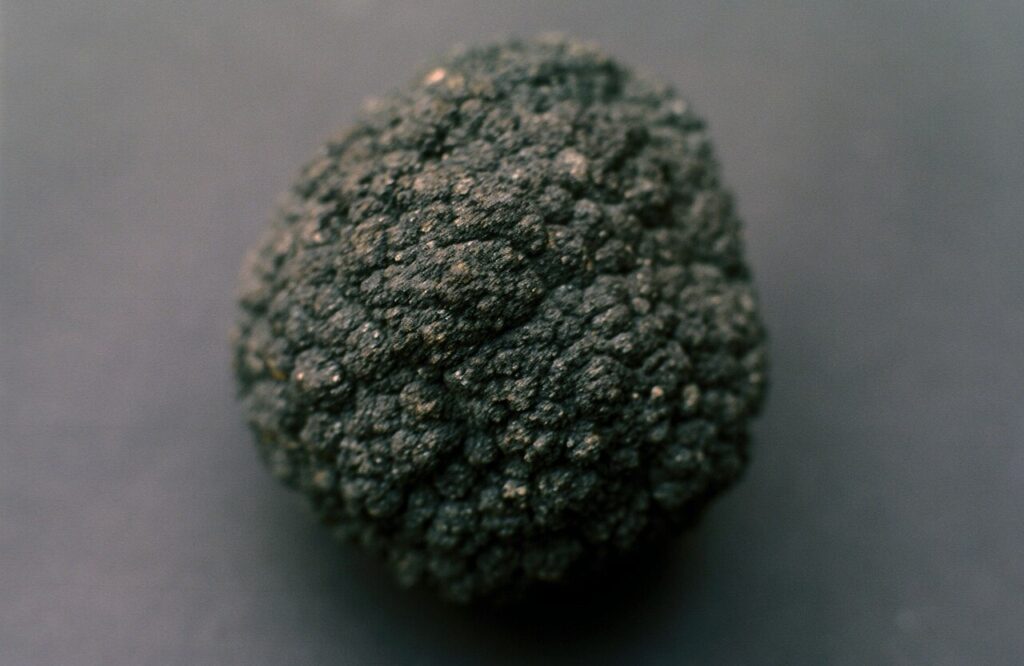
    Manganese nodule collected from the Pacific Ocean in 1982. Photo: Koelle, Wikimedia commons

    Facebook Twitter LinkedIn Email

    Processing is regarded as one of the most energy-intensive stages in a polymetallic nodule value chain. Conventional assessments typically assume pyrometallurgical routes, which benefit from existing smelting capacity but also account for a large share of emissions associated with deep-sea mineral production.

    A collaborative project involving TU Bergakademie Freiberg, the German Federal Institute for Geosciences and Natural Resources (BGR), and Aker BP is exploring alternative hydrometallurgical approaches that could significantly reduce energy use and environmental impact.

    Their work focuses on solid-state chlorination using crystalline ammonium chloride (NH₄Cl) to extract metals from polymetallic nodules. When heated, ammonium chloride decomposes into ammonia and hydrochloric acid, which drive the chlorination process. Upon cooling, excess gases recombine to form ammonium chloride again, allowing the reagent to be reused within a closed loop.

    The laboratory-scale process enables the production of concentrates of manganese, copper, nickel, zinc and cobalt. Excess ammonia can also be captured and converted into fertiliser, while metal chlorides are transferred to leaching and electrowinning stages for metal recovery.
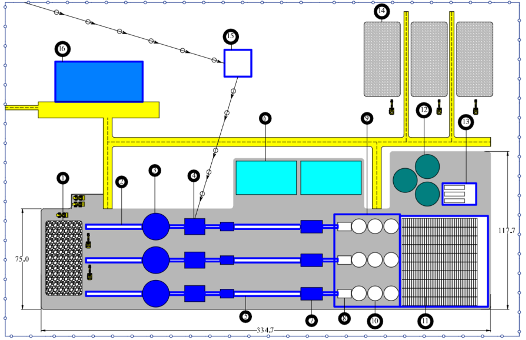
    Figure 1: Overview of a polymetallic nodule processing plant. 1. Dewatering and nodule storage. 2 – Drying unit. 3 – Silos. 4 – Mechanical processing. 5 – Solid-state chlorination. 6 – Central water supply. 7 – Off-gas treatment. 8 – Silos. 9/10 – Leaching unit. 11 – Electrowinning/liquid-liquid extraction. 12 – Thickeners. 13 – Solid–liquid extraction. 14 – Tailings. 15 – Central power supply. 16 – Administration, offices and labs. Source: Conference abstract

    Based on these results, the researchers conducted a preliminary economic assessment of a full-scale processing facility capable of treating three million tonnes of nodules annually, matching early production scenarios proposed for commercial nodule mining operations such as those planned by The Metals Company. The proposed flowsheet (see figure above) integrates drying, mechanical processing, chlorination, leaching and electrowinning units within a centralized plant design.

    A second approach explored in the study uses ammonium peroxodisulfate as an oxidising agent to improve the leaching efficiency of manganese crusts and seafloor massive sulphides found in the Norwegian Exclusive Economic Zone.

    Compared with commonly used hydrogen peroxide, this compound offers higher redox potential and greater thermal stability. Laboratory results show improved oxidation of manganese minerals and increased recovery of metals such as cobalt, molybdenum, vanadium, selenium and tungsten.

    The oxidising agent can be regenerated electrochemically, allowing the process to be powered by renewable energy sources such as hydropower. Inorganic residues from the process can also be converted into geopolymers, a material considered a potential low-carbon alternative to cement.

    According to the researchers, these laboratory-scale methods demonstrate the potential for climate-neutral, zero-solid-waste processing of deep-sea minerals while recovering the full metal content of nodules, crusts and massive sulphides.

    The work will be presented by Professor Markus Bertau (TU Bergakademie Freiberg) at Seabed Minerals 2026 in Bergen, March 24–26.

    Related Posts

    Seabed mining – life recovers

    mars 17, 2026

    First commercial recovery permit for seabed mining on the horizon

    mars 12, 2026

    Japan retrieves rare-earth-rich mud from 6,000 meters in deep-sea first

    mars 11, 2026
    Add A Comment
    Leave A Reply Cancel Reply

    NYHETSBREV
    Abonner på vårt nyhetsbrev
    geo365.no: ledende leverandør av nyheter og kunnskap som vedrører geofaget og geofaglige problemstillinger relatert til norsk samfunnsliv og næringsliv.
    KONFERANSER

    Havet endret seg brått rundt 1950 
    Mar 18, 2026

    Havet endret seg brått rundt 1950 

    A historic milestone
    Mar 14, 2026

    A historic milestone

    The dark oxygen controversy
    Mar 10, 2026

    The dark oxygen controversy

    Et gigantisk karbonlager 
    Mar 05, 2026

    Et gigantisk karbonlager 

    Et kosmisk sammenstøt i Polhavet
    Mar 03, 2026

    Et kosmisk sammenstøt i Polhavet

    A new frontier for Nigeria’s stranded associated gas
    Mar 18, 2026

    A new frontier for Nigeria’s stranded associated gas

    Inside every Basin you know is another Basin you haven’t met
    Mar 17, 2026

    Inside every Basin you know is another Basin you haven’t met

    How can we monitor North Sea carbon stores under wind farms and production platforms?
    Mar 16, 2026

    How can we monitor North Sea carbon stores under wind farms and production platforms?

    It doesn’t need to be clay mineral diagenesis
    Mar 13, 2026

    It doesn’t need to be clay mineral diagenesis

    How Bolivia’s search for additional petroleum resources relates to Devonian paleogeography and paleolatitude
    Mar 12, 2026

    How Bolivia’s search for additional petroleum resources relates to Devonian paleogeography and paleolatitude

    OLJEPRIS
    BCOUSD quotes by TradingView
    GULLPRIS
    GOLD quotes by TradingView
    KOBBERPRIS
    Track all markets on TradingView
    GeoPublishing AS

    GeoPublishing AS
    Trollkleiva 23
    N-1389 Heggedal

    Publisher & General Manager

    Ingvild Ryggen Carstens
    ingvild@geopublishing.no
    cell: +47 974 69 090

    Editor in Chief

    Ronny Setså
    ronny@geopublishing.no
    +47 901 08 659

    Media Guide

    Download Media Guide

    ABONNEMENT
    NYHETSBREV
    Abonner på vårt nyhetsbrev
    © 2026 GeoPublishing AS - All rights reserved.

    Type above and press Enter to search. Press Esc to cancel.