
US-based Glomar Minerals announced in early August that its subsidiary UK Seabed Resources Ltd. (UKSR) has begun a 65-day survey of the UK2 licence area in the Clarion-Clipperton Zone (CCZ) in the Pacific Ocean.
The campaign, conducted together with Earth Sciences New Zealand aboard the research vessel RV Tangaroa, is described as the first comprehensive geological and biological survey of the licence area in more than 40 years.
UKSR holds two exploration contracts for polymetallic nodules in the CCZ (UK1 and UK2) and a 19.9 % share of a third held by Ocean Mineral Singapore (OMS).
Together, the two wholly owned licences cover approximately 133,000 km² of deep seafloor in the Clarion-Clipperton Zone, a vast abyssal plain between Hawaii and Mexico that is widely regarded as the world’s most prospective area for polymetallic nodules.
According to previous resource calculations, the two licences contain about 750 million tonnes (Mt) of polymetallic nodules, hosting approximately 8 Mt of copper, 10 Mt of nickel and 1.4 Mt of cobalt, in addition to significant manganese resources. For comparison, global copper mine production reached approximately 23 Mt in 2025.
The new survey will collect geological, environmental and biological data intended to strengthen the company’s resource model and environmental baseline studies. According to Glomar, the campaign is an important step towards eventual commercial recovery of nodules from the seabed.
Norwegian roots
Although Glomar Minerals was founded in the United States, the company has strong ties to Norway.
The company acquired UKSR from the bankruptcy estate of Norwegian seabed mining company Loke Marine Minerals in 2025, which collapsed earlier that year after struggling to secure additional financing.
In many respects, Glomar could be described as a “Loke 2.0”. The company not only acquired Loke’s most valuable assets, the Pacific licences, but also brought much of the company’s leadership experience into the new organisation, including its former CEO, CFO and CTO.
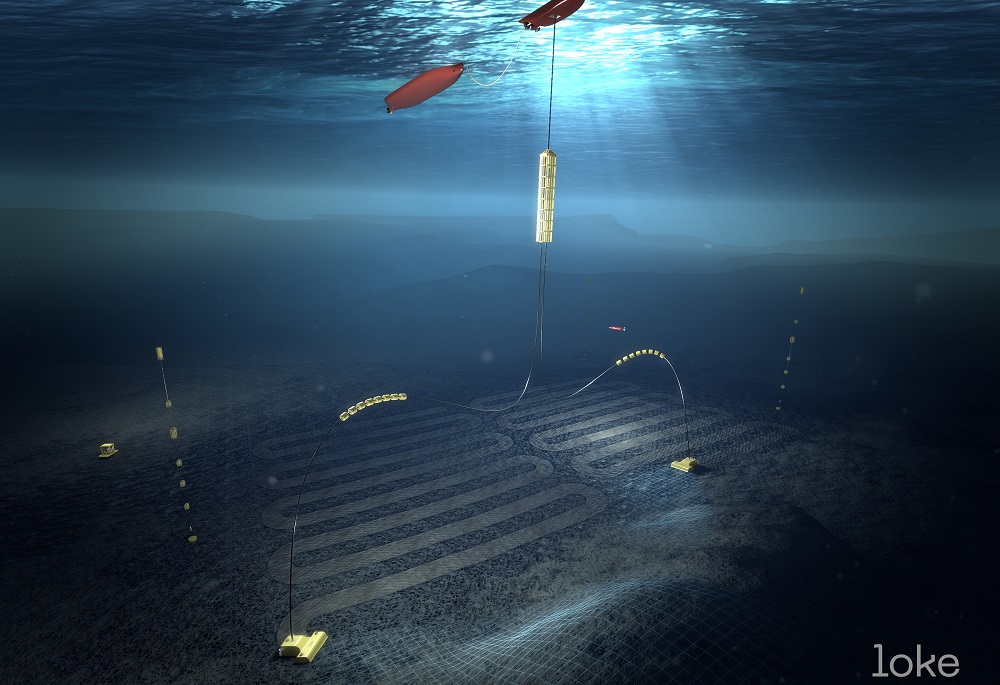
Glomar has also brought in parts of Loke’s technological legacy. Before its collapse, Loke and its partners invested heavily in developing concepts for the exploration, collection, and processing of nodules, drawing on experience and technology from the offshore oil and gas sector. Glomar continues to promote a similar strategy, emphasizing the transfer of proven deep-water technologies to reduce technical risk in the emerging seabed minerals industry.
Eyes on production
Speaking to Mining.com, Glomar CEO Chris Williams said the company aims to have nodules flowing through a planned US processing facility before the end of President Trump’s term, i.e. by January 2029.
The refinery project, known as Project Infinity, is being developed together with the Australian company Cobalt Blue Holdings. The two companies plan to process both polymetallic nodules and terrestrial cobalt feedstock at a modular US facility currently being evaluated at sites in Louisiana, North Carolina and Texas.
Glomar’s ambitions in the Pacific are, however, linked to the regulatory process at the International Seabed Authority (ISA), which is still working to finalize the regulations and overall framework that would allow for commercial mining in international waters. With uncertainty surrounding the timing of those regulations, the company is also evaluating alternative routes to production.
According to Williams, the company is looking at exclusive economic zones which could enable a smaller-scale mining operation to be developed ahead of the company’s larger ambitions in the CCZ.
While the current campaign focuses on UK2, that licence remains less advanced than UK1, which Williams has described as being at an advanced stage of exploration and potentially requiring only limited additional work before an exploitation application could be considered. The survey is expected to strengthen the geological and environmental dataset needed to further mature the licence.
For Glomar, the expedition aboard RV Tangaroa marks another step towards its ambition of building a vertically integrated seabed minerals business, spanning exploration, collection and processing of critical minerals.