Close Menu
    Facebook LinkedIn
    Geo365
    Facebook LinkedIn
    BESTILL Login ABONNÉR PÅ NYHETSBREV
    • Hjem
    • Anlegg og infrastruktur
    • Aktuelt
    • Bergindustri
    • Dyphavsmineraler
    • Miljø
    • Olje og gass
    • Geofunn
    • Download Media Guide
    Geo365
    You are at:Home » Scaling AI for hydrocarbon detection
    Olje og gass

    Scaling AI for hydrocarbon detection

    Bluware and Shell’s AI workflow revolutionizes hydrocarbon detection, scaling from research to real-world seismic analysis. This exciting use case will be presented at Dig X Subsurface 2025 in Oslo in December.
    By Redaksjonendesember 1, 2025
    Del denne artikkelen Facebook Twitter LinkedIn Email

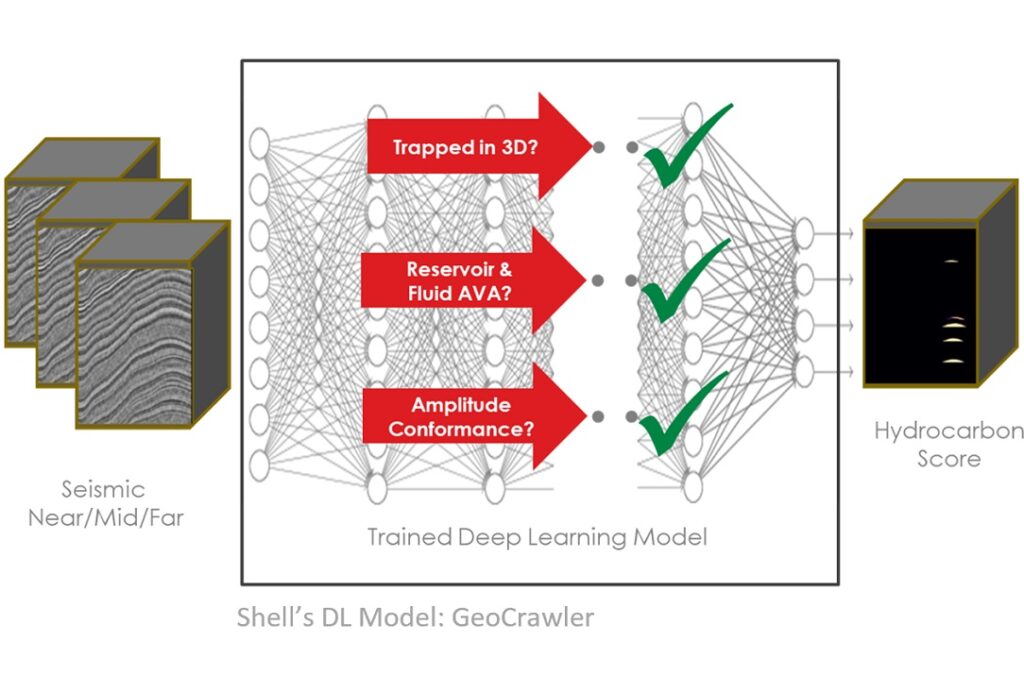
    Shell’s GeoCrawler, A Multi-task deep learning framework for Hydrocarbon Detection on Seismic data Image: Conference abstract / courtesy of Shell

    Facebook Twitter LinkedIn Email

    Detecting hydrocarbons directly from seismic data represents one of exploration’s biggest challenges and opportunities. Subtle amplitude anomalies can signal potential reservoirs but confirming them requires analysing multiple seismic cubes simultaneously and accounting for geological context – a process that demands both expertise and computation.

    Shell’s GeoCrawler, a multi-task deep learning framework, tackles this by detecting amplitude patterns, flat spots, and reservoir structures, boosting confidence in prospect evaluation. Yet, its large-scale models demanded High-Performance Computing (HPC) resources and coding expertise, limiting geoscientist access.

    To solve this, Bluware deployed GeoCrawler on a scalable cloud platform using the VDS format, optimized for compressing and accessing large seismic data.

    A custom connector links on-premise data to the cloud, integrating with geoscience tools. Bluware’s GPU-accelerated engine and Kubernetes clusters enable fast, parallel processing, cutting analysis time from weeks to hours.

    The result is a robust end-to-end system where geoscientists can access AI-powered seismic interpretation directly – without deep coding skills or reliance on dedicated HPC clusters. The approach cuts processing time from weeks to hours and enables global collaboration, flexible scaling, and cost-efficient cloud deployment.

    For AI developers, the framework also provides a faster path from research to production, allowing rapid iteration and deployment of new models with real-world data.

    The Bluware–Shell collaboration, presented by Bluware’s Morten Ofstad at Dig X Subsurface 2025, demonstrates how operationalising AI is not only a technical achievement but a step toward making advanced hydrocarbon detection faster, scalable, and accessible for geoscientists worldwide.

    Join us at Scandic Fornebu, December 03-04, 2025, to learn more. The program can be found on the conference website.

    Related Posts

    Fant opptil 50 millioner fat ved Oseberg

    oktober 28, 2026

    Mer gass ved Gullfaks

    oktober 19, 2026

    Både WWF og Offshore Norge er fornøyde

    oktober 14, 2026
    Add A Comment

    Comments are closed.

    NYHETSBREV
    Abonner på vårt nyhetsbrev
    geo365.no: ledende leverandør av nyheter og kunnskap som vedrører geofaget og geofaglige problemstillinger relatert til norsk samfunnsliv og næringsliv.
    KONFERANSER

    Turning remarks to records
    Oct 28, 2026

    Turning remarks to records

    DNV-midler til tre mineralprosjekter
    Oct 27, 2026

    DNV-midler til tre mineralprosjekter

    Leser linjene i terrenget
    Oct 22, 2026

    Leser linjene i terrenget

    AI still can’t beat the palynologist
    Oct 16, 2026

    AI still can’t beat the palynologist

    Tettere på terra incognita
    Oct 13, 2026

    Tettere på terra incognita

    The end of Eavor?
    Oct 31, 2026

    The end of Eavor?

    Top-Down and Bottom-Up
    Oct 30, 2026

    Top-Down and Bottom-Up

    Unlocking a century of subsurface intelligence
    Oct 29, 2026

    Unlocking a century of subsurface intelligence

    Why the Rittershoffen geothermal plant came to a halt
    Oct 28, 2026

    Why the Rittershoffen geothermal plant came to a halt

    Côte d’Ivoire: Reimaged datasets provide new geological insights within an exploration hotspot
    Oct 27, 2026

    Côte d’Ivoire: Reimaged datasets provide new geological insights within an exploration hotspot

    OLJEPRIS
    BCOUSD quotes by TradingView
    GULLPRIS
    GOLD quotes by TradingView
    KOBBERPRIS
    Track all markets on TradingView
    GeoPublishing AS

    GeoPublishing AS
    Trollkleiva 23
    N-1389 Heggedal

    Publisher & General Manager

    Ingvild Ryggen Carstens
    ingvild@geopublishing.no
    cell: +47 974 69 090

    Editor in Chief

    Ronny Setså
    ronny@geopublishing.no
    +47 901 08 659

    Media Guide

    Download Media Guide

    ABONNEMENT
    NYHETSBREV
    Abonner på vårt nyhetsbrev
    © 2026 GeoPublishing AS - All rights reserved.

    Type above and press Enter to search. Press Esc to cancel.