
This story was first published on GEO EXPRO.
– If you talk to organisations opposing seabed mineral extraction, they all speak about the terrible environmental damage that this will cause. But none of them relate this to technology and the role it plays in reducing the environmental impact, says Annemiek Vink.
Annemiek works at the BGR in Hannover, Germany, and has been closely involved in research projects analysing the potential effects of seabed mineral extraction for a long time.
– The link between environmental damage and technology is very strong, with bad technologies producing a much more pronounced impact than more advanced methods. In other words, I feel that the debate is incomplete without involving an informed contribution from the technology side when discussing the impacts of seabed mineral extraction.
– For instance, when we look at harvesting polymetallic nodules from the seafloor, the sediment plume that is generated by modern machines that suck up the nodules as they drive across the seafloor is much more confined than modellers were predicting about a decade ago. Rather than dispersal over hundreds of kilometres, it is rather 1 to maximally 2 km instead, and remains very close to the seafloor.
– I also know that GSR, the Belgian company that built one of the first prototypes of a tracked nodule collector, which was tested at 4.5 km depth in 2021, have identified more than 10 ways to adapt and change their collector to reduce water and sediment intake and maximise the density of the particles that are being ejected, so that they settle even faster.
– At the same time, there is no getting away from the fact that any machine driving across the seafloor will inevitably cause a plume of some dimension, adds Annemiek.
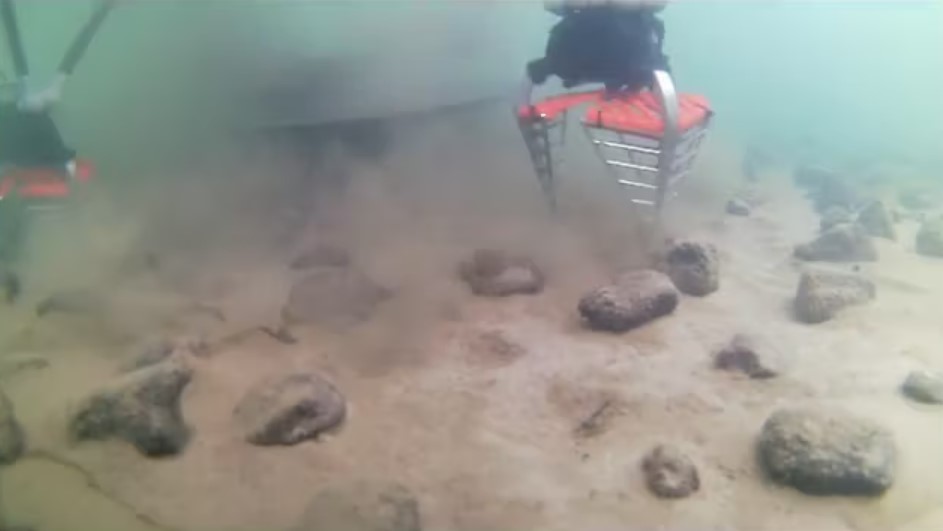
– But companies are looking at other ways of doing this. For instance, Impossible Metals, a US-Canadian start-up company, is looking at AUV’s that hover over the seafloor to pick up the nodules mechanically with considerably less disruption of the seafloor sediment.
Seabed Minerals 2026
24-26 March 2026
Bergen, Norway
Then there is the concern about mid-water plumes, which are caused by the return fluid stream once the nodules have been separated from surplus water, sediment and nodule fines on the surface vessel. There is abundant life at mid-water depths, causing serious concern with stakeholders.
– However, there is no need for mid-water plumes at all. Return fluids can be brought back entirely to where they came from, or there are ways to engineer things in such a way that there is no return fluid required at all. Yes, these will be more expensive solutions, but if that is the price we need to pay for a more responsible extraction, we have to accept that.
– What all this shows is that we do need to incorporate technology into the public debate about seabed mineral extraction, as it is technology that will be able to facilitate shifts in the environmental impact to an extent that it could be acceptable to move forward, Annemiek concludes.