
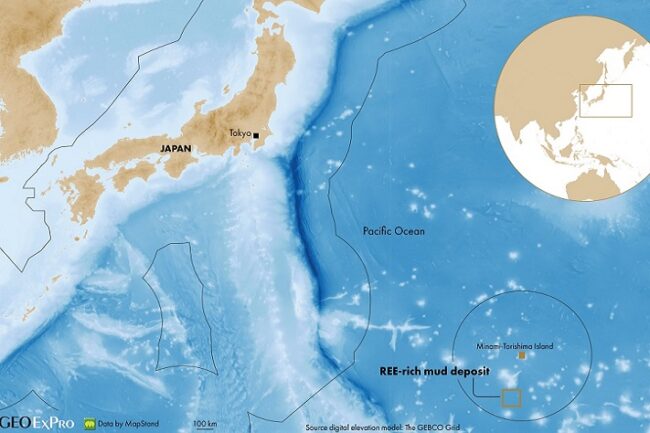
Japan has successfully retrieved sediment containing rare earth elements (REE) from the seabed off Minami-Torishima Island (Marcus Island) in the Pacific Ocean, some 1,900 kilometers southeast of Tokyo.
At nearly 6,000 meters below the sea surface, the mission marked what the government describes as the world’s first test recovery of rare-earth-rich deep-sea muds at such depths.
First identified by the Japan Agency for Marine-Earth Science and Technology (JAMSTEC) in 2013, this deposit could provide Japan with a stable, long-term supply of REEs critical to its high-tech, energy, and defense industries.
According to The Japan Times, the sediment samples will undergo detailed laboratory analysis, including to determine the content of REEs. Kei Sato, a government spokesperson, called the retrieval «a meaningful achievement both in terms of economic security and comprehensive maritime development.»
Japan’s industry is heavily dependent on imported REEs, with the majority supplied by China. This dependency has long been recognized as a vulnerability. Japan remembers well the 2010 incident when China restricted rare earth exports amid a diplomatic dispute, causing a spike in global prices and raising concerns about supply chain security. Securing domestic sources is therefore a key motivation for exploring deep-sea deposits.
The deposit
The Minami-Torishima deposit lies entirely within Japan’s exclusive economic zone (EEZ), which simplifies legal and regulatory issues compared with international waters. Early estimates suggest that the deposit may contain 16 million tonnes of REE oxides. The most promising area (102 km2) and the uppermost ten meters of the mud could yield 1.2 million tonnes of REE oxide, potentially meeting global demand for yttrium, europium, terbium, and dysprosium for decades.
A 2018 Nature Scientific Reports article reported core samples with REE and yttrium grades of up to 5,000 ppm (0.5 %), comparable to many global, terrestrial deposits. Separation and selective processing could enhance the resource’s economic value by increasing the grade in the lifted mud.
The mud itself represents a unique geological formation. A 1990 research article noted that REE-rich muds in the Pacific, like those near Minami-Torishima, contain fish-bone debris composed of biogenic calcium phosphate, which accumulates REEs from seawater. Low sedimentation rates and high biological productivity have contributed to the formation of thick, REE-enriched layers, establishing this as a distinct fourth type of deep-sea mineral resource, alongside nodules, massive sulfides, and polymetallic crusts.
Seabed Minerals 2026
24-26 March 2026
Bergen, Norway
A challenging undertaking
Unlike solid nodules, sulfides, and crusts, REE-rich muds targeted in this project have the consistency of clay and cannot simply be scraped or dredged like harder ores.
According to a Nature sponsored feature, Japanese engineers have been working on developing a “subsea factory” system: machinery placed on the seafloor mixes the mud with seawater, mills it into fine particles, and pumps it as a slurry through reinforced riser pipes to the surface.
Developers from JAMSTEC, Toyo Engineering, and TOA Corporation have spent several years addressing multiple hurdles.
Building pipes capable of reaching nearly 6,000 m while withstanding immense pressure, abrasion, and constant stress is a significant engineering challenge, as industrial risers are mostly designed for shallower operations.
On the seabed, machinery must function reliably in near‑total darkness and extreme pressure to agitate and feed the mud into the riser. Early development work has also highlighted that underlying sediment layers are weaker than expected, which could complicate operations.
Even if extraction technology proves feasible, refining rare earths from the complex mixture recovered remains a separate challenge, as advanced separation and processing capacity is concentrated in very few countries, and Japan’s own refining infrastructure may need to be adapted and expanded to handle any future output.
If the lab analysis yields positive results, the project partners have previously stated that they aim to initiate trial operations in January 2027, using a system capable of extracting 350 tons of mud per day.
For now, the January 2026 mission represents a significant proof-of-concept, demonstrating that rare-earth-rich mud can be accessed and recovered from extreme ocean depths. The results place Japan at the forefront of developing deep-sea mining concepts and technologies, although whether extraction and processing will be commercial remains to be seen.
1 kommentar
This development is quite significant, especially in terms of reducing dependence on external suppliers and strengthening economic security. However, I’m curious about the environmental risks of deep-sea mining at such extreme depths. How can Japan balance resource extraction with the protection of fragile ocean ecosystems?