Close Menu
    Facebook LinkedIn
    Geo365
    Facebook LinkedIn
    BESTILL Login ABONNÉR PÅ NYHETSBREV
    • Hjem
    • Anlegg og infrastruktur
    • Aktuelt
    • Bergindustri
    • Dyphavsmineraler
    • Miljø
    • Olje og gass
    • Geofunn
    • Download Media Guide
    Geo365
    You are at:Home » First commercial recovery permit for seabed mining on the horizon
    Dyphavsmineraler

    First commercial recovery permit for seabed mining on the horizon

    By Mariel Reitsmamars 12, 2026
    Del denne artikkelen Facebook Twitter LinkedIn Email
    The US government has streamlined exploration and exploitation licence applications for seabed mining in international waters. This bypasses the International Seabed Authority (ISA), which has been slow in establishing a governance structure for commercial mineral recovery.

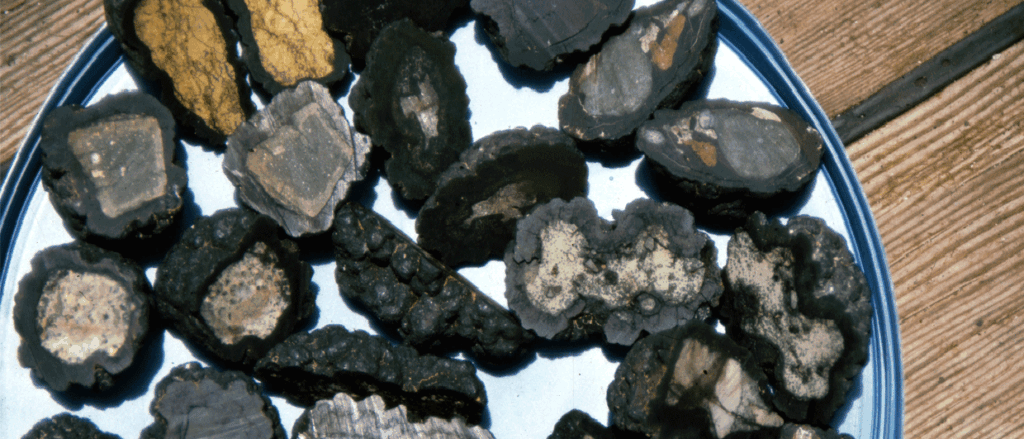
    Ferromanganese nodules collected from seamounts in the Pacific Ocean. Credit: US Geological Survey.

    Facebook Twitter LinkedIn Email

    The national Oceanic and At­mospheric Administration (NOAA), an agency within the US Department of Com­merce, recently updated regulations regarding seabed mineral exploration and commercial recovery. The updated framework allows US companies not only to apply for a permit to explore for seabed minerals in areas beyond national jurisdiction, but also to com­mercially recover them.

    In other words, qualified appli­cants can now submit exploration and commercial recovery information to­gether, and may incorporate environ­mental, geological, and engineering data collected during exploration ac­tivities directly into commercial recov­ery permit applications.

    One company responded to that change in regulation immediately. A day after the framework update came into effect, the US subsidiary of The Metals Company (TMC) sub­mitted a consolidated application for an exploration licence and a commer­cial recovery permit for polymetallic nodules in international waters of the Clarion Clipperton Zone (CCZ) in the Pacific Ocean.

    TMC recently announced that the application was deemed by NOAA to be «in substantial compliance» with the Deep Seabed Hard Mineral Resources Act and its regulations – a key step forward for securing a permit.

    Seabed Minerals 2026

    24-26 March 2026

    Bergen, Norway

    PROGRAM AND REGISTRATION

    The Metals Company has already explored the CCZ thanks to its part­nership with the Pacific Island coun­tries of Nauru and Tonga, holding exploration licences issued by the ISA under UN law. But apart from a pro­duction test, these licences do not al­low commercial production.

    And to date, the ISA has not man­aged to come up with an agreed frame­work that offers guidelines on how companies can be awarded a produc­tion licence, much to the frustration of the industry. So, if NOAA grants its first commercial recovery permit to The Metals Company, it could mark the inauguration of commercial sea­bed mining in international waters.

    In a 35-page response to these de­velopments, the ISA stated: “Any com­mercial exploitation outside of nation­al jurisdiction carried out without the authorisation of ISA would constitute a violation of international law.”

    The CCZ is located between Hawaii and Mexico, and includes the Clarion fracture zone in the north, the Clipperton fracture zone in the south and the adjoining abyssal plain. It is rich in polymetallic nodules, loosely scattered on the seabed, that contain four base metals: cobalt, nickel, copper and manganese, in a single ore.
    TMC designed a nodule collection system that creates a suction force to coax
    the nodules into the collector without digging or dredging. The sediment is then washed off the nodules and deposited back on the sea floor before the nodules travel 4,200 m up the riser to the production vessel.
    Once aboard, nodules are dewatered and residual water, sediment and nodule fines are sent back to a depth of 2,000 m via the return pipe. This is a strategically chosen depth, well below the productive upper ocean layers and bypassing 95 % of marine life. The polymetallic nodules will subsequently be processed onshore, leaving minimal tailings behind because most of the ore can be used.

    Related Posts

    Japan retrieves rare-earth-rich mud from 6,000 meters in deep-sea first

    mars 11, 2026

    European ambivalence on seabed mining

    mars 1, 2026

    Technology is always missing in the debate about seabed mineral extraction

    februar 23, 2026
    Add A Comment
    Leave A Reply Cancel Reply

    NYHETSBREV
    Abonner på vårt nyhetsbrev
    geo365.no: ledende leverandør av nyheter og kunnskap som vedrører geofaget og geofaglige problemstillinger relatert til norsk samfunnsliv og næringsliv.
    KONFERANSER

    The dark oxygen controversy
    Mar 10, 2026

    The dark oxygen controversy

    Et gigantisk karbonlager 
    Mar 05, 2026

    Et gigantisk karbonlager 

    Et kosmisk sammenstøt i Polhavet
    Mar 03, 2026

    Et kosmisk sammenstøt i Polhavet

    Asteroidenedslag kan endre livet på jorda 
    Feb 26, 2026

    Asteroidenedslag kan endre livet på jorda 

    Meteorer: Bardufoss
    Feb 24, 2026

    Meteorer: Bardufoss

    Collaborative solutions to above-ground exploration challenges
    Mar 11, 2026

    Collaborative solutions to above-ground exploration challenges

    Recognising structural inversion
    Mar 11, 2026

    Recognising structural inversion

    Moroccan Atlantic Margin: Where geological diversity meets outstanding exploration potential
    Mar 10, 2026

    Moroccan Atlantic Margin: Where geological diversity meets outstanding exploration potential

    What words mean
    Mar 09, 2026

    What words mean

    A blowout in Mexico
    Mar 08, 2026

    A blowout in Mexico

    OLJEPRIS
    BCOUSD quotes by TradingView
    GULLPRIS
    GOLD quotes by TradingView
    KOBBERPRIS
    Track all markets on TradingView
    GeoPublishing AS

    GeoPublishing AS
    Trollkleiva 23
    N-1389 Heggedal

    Publisher & General Manager

    Ingvild Ryggen Carstens
    ingvild@geopublishing.no
    cell: +47 974 69 090

    Editor in Chief

    Ronny Setså
    ronny@geopublishing.no
    +47 901 08 659

    Media Guide

    Download Media Guide

    ABONNEMENT
    NYHETSBREV
    Abonner på vårt nyhetsbrev
    © 2026 GeoPublishing AS - All rights reserved.

    Type above and press Enter to search. Press Esc to cancel.