Close Menu
    Facebook LinkedIn
    Geo365
    Facebook LinkedIn
    BESTILL Login ABONNÉR PÅ NYHETSBREV
    • Hjem
    • Anlegg og infrastruktur
    • Aktuelt
    • Bergindustri
    • Dyphavsmineraler
    • Miljø
    • Olje og gass
    • Geofunn
    • Download Media Guide
    Geo365
    You are at:Home » Movement towards a mining moratorium
    Dyphavsmineraler

    Movement towards a mining moratorium

    Whilst a lot of work is currently being done to formulate a mining code for the exploitation of deep-sea minerals in international waters, the call to ban metal extraction from the High Seas is just as loud. A multitude of governments and tech companies are in support of this.
    By Mariel Reitsmaaugust 4, 2026
    Del denne artikkelen Facebook Twitter LinkedIn Email

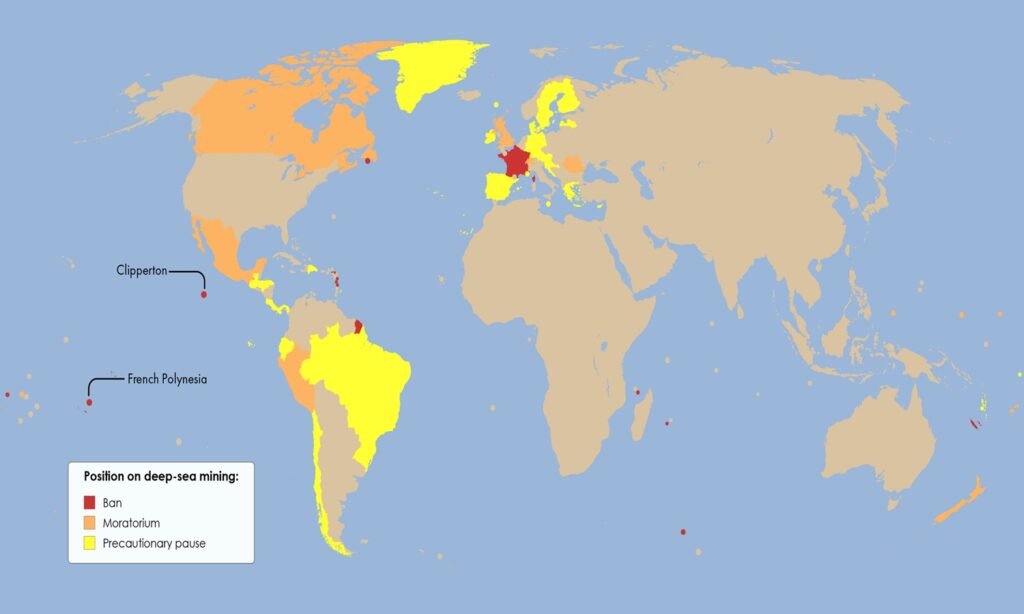
    Map of countries in support of the deep-sea mining moratorium proposed by the DSCC. Cartography: Created with mapchart.net

    Facebook Twitter LinkedIn Email

    Mining in international waters is a hotly debated topic. One of the discussion points is environmental concerns about the effect of mining on the unique and poorly understood abyssal plain ecosystem. The Deep-Sea Conservation Coalition (DSCC) is passionate about protecting the marine environment. Their overarching goal is to substantially reduce the greatest threats to life in the deep sea and to safeguard the long-term integrity of the ecosystem. Threats include pollutants, plastic and climate change, but also proposed deep-sea mining activities.

    Although the International Seabed Authority (ISA) is still working on a mining code and has yet to give the green light for deep-sea mineral exploitation, the DSCC is already calling for a mining moratorium. So far, forty countries have taken a stance against mining in international waters. The majority of these countries are in favour of a precautionary pause to allow more time for further research and regulatory development, exactly what ISA is working on. A more select group calls for a formal agreement to temporarily prohibit deep-sea mining. France is the only country to call for a complete ban. That is surprising, since France has the largest exclusive economic zone (EEZ) out of all countries, thanks to its overseas territories dotted around four of the world’s oceans. However, it applies the same rule in its own waters; it is not exploiting its marine metallic resources, even though much of France’s EEZ is highly prospective.

    On the seamounts surrounding French Polynesia, for example, iron-manganese crusts enriched in cobalt and platinum have formed. Regardless of the economic promise, the indigenous Polynesian population is in agreement with the ban; they have environmental concerns and regard the ocean as a sacred and spiritual place.

    The 200 nautical mile radius around Clipperton Island is undoubtedly rich in polymetallic nodules, like the rest of the Clarion-Clipperton zone. France claimed the uninhabited atoll in 1858, being the only surface exposure of the much-explored Clipperton Fracture Zone, of which the majority resides in international waters.

    But it is not only governments calling for a moratorium; 71 companies have signed a similar appeal by WWF. Among them are multiple car manufacturers and tech companies. This is interesting because these types of companies are often mentioned as beneficiaries of deep-sea minerals. The metals can be used to manufacture EV batteries, while rare earth elements are needed for technology to function at high standards. Clearly, Volkswagen, BMW, Apple, Philips and others are confident that terrestrial supply will be sufficient.

    Related Posts

    Mounds, layers and sands of ore

    juli 28, 2026

    Ny vurdering av det ukjente

    juni 7, 2026

    Knytter mineralfunn til Framstredets åpning

    juni 2, 2026
    Add A Comment
    Leave A Reply Cancel Reply

    NYHETSBREV
    Abonner på vårt nyhetsbrev
    geo365.no: ledende leverandør av nyheter og kunnskap som vedrører geofaget og geofaglige problemstillinger relatert til norsk samfunnsliv og næringsliv.
    KONFERANSER

    Dig X Subsurface – Call for abstracts
    Aug 14, 2026

    Dig X Subsurface – Call for abstracts

    Et spektakulært himmelfenomen
    Aug 12, 2026

    Et spektakulært himmelfenomen

    Grønlandsisen nådde sokkelen tidligere enn antatt 
    Aug 11, 2026

    Grønlandsisen nådde sokkelen tidligere enn antatt 

    Varangerhalvøyas dype hemmelighet
    Aug 07, 2026

    Varangerhalvøyas dype hemmelighet

    Vil norsk industri omfavne CCS?
    Aug 04, 2026

    Vil norsk industri omfavne CCS?

    Mediterranean eyes on Greece as deepwater drilling approaches
    Aug 17, 2026

    Mediterranean eyes on Greece as deepwater drilling approaches

    The inconvenient truth about pore pressure prediction in unconventional plays
    Aug 14, 2026

    The inconvenient truth about pore pressure prediction in unconventional plays

    Ghana’s next frontier: The Voltaian Basin
    Aug 13, 2026

    Ghana’s next frontier: The Voltaian Basin

    Exploration drilling programme in Greenland postponed and slimmed down
    Aug 12, 2026

    Exploration drilling programme in Greenland postponed and slimmed down

    Is helium the bonus or the business?
    Aug 12, 2026

    Is helium the bonus or the business?

    OLJEPRIS
    BCOUSD quotes by TradingView
    GULLPRIS
    GOLD quotes by TradingView
    KOBBERPRIS
    Track all markets on TradingView
    GeoPublishing AS

    GeoPublishing AS
    Trollkleiva 23
    N-1389 Heggedal

    Publisher & General Manager

    Ingvild Ryggen Carstens
    ingvild@geopublishing.no
    cell: +47 974 69 090

    Editor in Chief

    Ronny Setså
    ronny@geopublishing.no
    +47 901 08 659

    Media Guide

    Download Media Guide

    ABONNEMENT
    NYHETSBREV
    Abonner på vårt nyhetsbrev
    © 2026 GeoPublishing AS - All rights reserved.

    Type above and press Enter to search. Press Esc to cancel.