Close Menu
    Facebook LinkedIn
    Geo365
    Facebook LinkedIn
    BESTILL Login ABONNÉR PÅ NYHETSBREV
    • Hjem
    • Anlegg og infrastruktur
    • Aktuelt
    • Bergindustri
    • Dyphavsmineraler
    • Miljø
    • Olje og gass
    • Geofunn
    • Download Media Guide
    Geo365
    You are at:Home » A pragmatic approach to seabed mining
    Dyphavsmineraler

    A pragmatic approach to seabed mining

    Biologist Annemiek Vink from German Research Institute BGR believes that seabed mining should be considered as an option given the circumstances we find ourselves in, adding a well-balanced view to a polarised debate.
    By Henk Kombrinkfebruar 4, 2026
    Del denne artikkelen Facebook Twitter LinkedIn Email

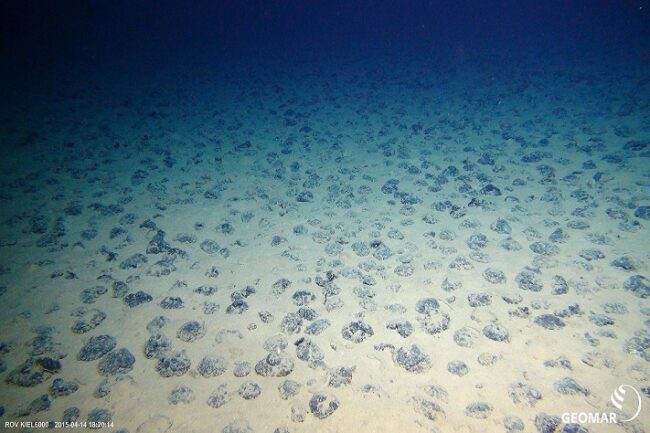
    Polymetallic nodules in the Clarion-Clipperton Zone in the Pacific Ocean. Source: ROV KIEL 6000, GEOMAR

    Facebook Twitter LinkedIn Email

    This story was first published on GEO EXPRO in 2025.

    – I do obviously worry about the ecosystems down at the seafloor, says biologist Annemiek Vink from the Bundesanstalt für Geowissenschaften und Rohstoffe (BGR) in Hannover when we meet on Teams.

    – On the other hand, I also appreciate the impressive size of the resource.

    – There are environmentalists who claim that if you remove all the nodules, an entire ecosystem will be lost. But that is impossible, because the areal extent of these nodule fields is so huge that it will never be possible to mine it all. In fact, even if we were to aim to mine 20% of it, it would still take us hundreds and hundreds of years to do it.

    – If you see these nodules lying on the seafloor through the camera of an ROV, and you know that that seascape continues on for hundreds of kilometers, it makes you more aware of the sheer scale of the area these nodules are covering, adds Annemiek.

    The Clarion Clipperton Zone (CCZ) alone is equal to the size of Europe.

    However, it is only a smaller part of that total area that lends itself for seabed mining. There are mountainous areas where mining would be much more complicated, in addition to areas where the density of nodules does not make a mining exercise an economic exercise in the first place.

    – Taking these things into consideration, it is 20% of the CCZ that is mineable at most, explains Annemiek.

    Seabed Minerals 2026

    24-26 March 2026

    Bergen, Norway

    PROGRAM AND REGISTRATION

    Unique ecosystems

    – Most of the species we find in this environment are rare; it’s not like in forests where you see many common types of trees or birds across large regions with some rarer species alongside, says Annemiek.

    – That means diversity is high and difficult to quantify, with the implication that we will never be 100% sure what species reside at every location. However, I feel that we should not even try to attempt to do that, simply because that would be an overly complicated and impossible task, also because we are not nearly close to having this information on land either.

    – Instead, what we need is a pragmatic approach and a process that allows us to protect important parts of this ecosystem without the need to completely avoid other activities. In my view, that is possible. If we can have large and ecologically robust protected areas that are 80% similar to the areas that will be mined, we are already in a good position. This will also help re-colonize mined areas.

    Two exploration contracts

    Germany has two contracts for the exploration of seabed minerals in international waters; one in the Indian Ocean for polymetallic massive sulphides and the other in the CCZ for polymetallic nodules. Annemiek coordinates the polymetallic nodules project in the CCZ, which started as far back as 2006. Meanwhile, about 80% of the work in the area relates to environmental baseline and impact studies.

    Related Posts

    Ny vurdering av det ukjente

    juni 7, 2026

    Knytter mineralfunn til Framstredets åpning

    juni 2, 2026

    Demonstrerte mulighetene – satt på pause

    mars 25, 2026
    Add A Comment

    Comments are closed.

    NYHETSBREV
    Abonner på vårt nyhetsbrev
    geo365.no: ledende leverandør av nyheter og kunnskap som vedrører geofaget og geofaglige problemstillinger relatert til norsk samfunnsliv og næringsliv.
    KONFERANSER

    There’s metals in them hills
    Jul 07, 2026

    There’s metals in them hills

    Skal lede Norges storsatsing i Polhavet
    Jul 02, 2026

    Skal lede Norges storsatsing i Polhavet

    Varangerhalvøyas dype hemmelighet
    Jun 30, 2026

    Varangerhalvøyas dype hemmelighet

    Dig X Subsurface – Call for abstracts
    Jun 26, 2026

    Dig X Subsurface – Call for abstracts

    Oslo-skjelv ga uante konsekvenser
    Jun 24, 2026

    Oslo-skjelv ga uante konsekvenser

    Before you decide to enter Venezuela…
    Jul 07, 2026

    Before you decide to enter Venezuela…

    North Slope leasing, exploration, and development
    Jul 07, 2026

    North Slope leasing, exploration, and development

    Storing heat in basement rocks
    Jul 06, 2026

    Storing heat in basement rocks

    The end of the expat – the end of an era?
    Jul 03, 2026

    The end of the expat – the end of an era?

    Why high oil prices can also be a bad thing for the energy transition
    Jul 03, 2026

    Why high oil prices can also be a bad thing for the energy transition

    OLJEPRIS
    BCOUSD quotes by TradingView
    GULLPRIS
    GOLD quotes by TradingView
    KOBBERPRIS
    Track all markets on TradingView
    GeoPublishing AS

    GeoPublishing AS
    Trollkleiva 23
    N-1389 Heggedal

    Publisher & General Manager

    Ingvild Ryggen Carstens
    ingvild@geopublishing.no
    cell: +47 974 69 090

    Editor in Chief

    Ronny Setså
    ronny@geopublishing.no
    +47 901 08 659

    Media Guide

    Download Media Guide

    ABONNEMENT
    NYHETSBREV
    Abonner på vårt nyhetsbrev
    © 2026 GeoPublishing AS - All rights reserved.

    Type above and press Enter to search. Press Esc to cancel.