Close Menu
    Facebook LinkedIn
    Geo365
    Facebook LinkedIn
    BESTILL Login ABONNÉR PÅ NYHETSBREV
    • Hjem
    • Anlegg og infrastruktur
    • Aktuelt
    • Bergindustri
    • Dyphavsmineraler
    • Miljø
    • Olje og gass
    • Geofunn
    • Download Media Guide
    Geo365
    You are at:Home » Deep-sea mud trial extraction to begin in 2026
    Dyphavsmineraler

    Deep-sea mud trial extraction to begin in 2026

    Japan will start test mining of REE-rich muds from the seabed in January of next year. Pending a successful outcome, this may lead to a ramp-up to 350 tons per day starting in 2027.
    By Ronny Setsånovember 16, 2025
    Del denne artikkelen Facebook Twitter LinkedIn Email
    Facebook Twitter LinkedIn Email

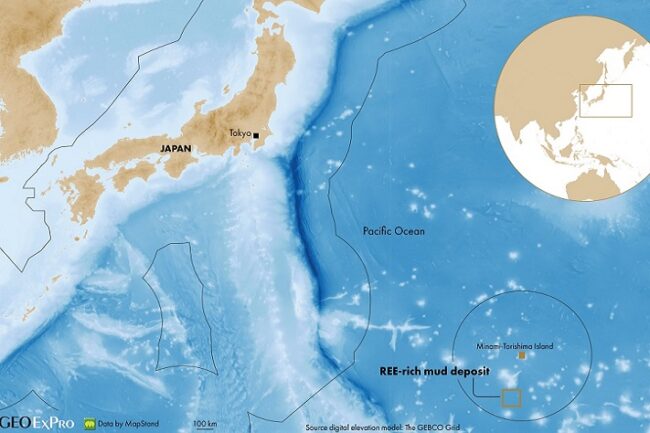
    Japan is set to launch test mining of a unique deposit of rare earths element (REE)-rich deposit in an area off the Minami-Torishima Island (Marcus Island) in the Pacific Ocean, some 1 900 kilometers southeast of Tokyo.

    First identified by the Japan Agency for Marine-Earth Science and Technology (JAMSTEC) in 2013, this deposit could provide Japan with a stable, long-term supply of REEs to meet its industrial demands.

    According to Reuters, the test mining will commence in January 2026. Pipes from a JAMSTEC deep-sea exploration vessel will extract the mud, which will be transported to the mainland for analysis to assess its metal content.

    «The goal is to secure a domestic supply to enhance national security, rather than to enable private companies to profit from selling rare earths. This would mark the world’s first attempt to extract mud from the deep seabed for the separation and refining of rare earth elements”, said Shoichi Ishii, program director of the Cabinet Office’s national platform for innovative ocean developments, in an interview with the news agency.

    If the analysis yields positive results, the project aims to initiate trial operations in January 2027, using a system capable of extracting 350 tons of mud per day.

    While the concept is straightforward, the deposit lies at depths of 5,000 to 6,000 meters, posing significant challenges for the pumps and pipes required for extraction.

    Located within Japan’s exclusive economic zone (EEZ), the deposit’s potential justifies the effort.

    A 2018 Nature Scientific Reports article reported core samples with REE and yttrium grades of up to 5,000 ppm (0.5 %), comparable to many global deposits. Separation and selective processing could enhance the resource’s economic value by increasing the grade in the lifted mud.

    The most promising area (102 km2) and the uppermost ten meters of the mud could yield 1.2 million tons of REE oxide, potentially meeting global demand for yttrium, europium, terbium, and dysprosium for decades. Across the entire study area, the supply could last centuries.

    A 1990 research article noted that REE-rich muds in the Pacific, like those near Minami-Torishima, contain fish-bone debris composed of biogenic calcium phosphate, which accumulates REEs from seawater. Low sedimentation rates and high biological productivity have contributed to the formation of these deposits, making them a lesser-known fourth type of deep-sea mineral resource, alongside nodules, massive sulfides, and polymetallic crusts.

    Related Posts

    First commercial recovery permit for seabed mining on the horizon

    mars 12, 2026

    Japan retrieves rare-earth-rich mud from 6,000 meters in deep-sea first

    mars 11, 2026

    European ambivalence on seabed mining

    mars 1, 2026
    Add A Comment

    Comments are closed.

    NYHETSBREV
    Abonner på vårt nyhetsbrev
    geo365.no: ledende leverandør av nyheter og kunnskap som vedrører geofaget og geofaglige problemstillinger relatert til norsk samfunnsliv og næringsliv.
    KONFERANSER

    A historic milestone
    Mar 12, 2026

    A historic milestone

    The dark oxygen controversy
    Mar 10, 2026

    The dark oxygen controversy

    Et gigantisk karbonlager 
    Mar 05, 2026

    Et gigantisk karbonlager 

    Et kosmisk sammenstøt i Polhavet
    Mar 03, 2026

    Et kosmisk sammenstøt i Polhavet

    Asteroidenedslag kan endre livet på jorda 
    Feb 26, 2026

    Asteroidenedslag kan endre livet på jorda 

    It doesn’t need to be clay mineral diagenesis
    Mar 13, 2026

    It doesn’t need to be clay mineral diagenesis

    How Bolivia’s search for additional petroleum resources relates to Devonian paleogeography and paleolatitude
    Mar 12, 2026

    How Bolivia’s search for additional petroleum resources relates to Devonian paleogeography and paleolatitude

    Moroccan Atlantic Margin: Where geological diversity meets outstanding exploration potential
    Mar 12, 2026

    Moroccan Atlantic Margin: Where geological diversity meets outstanding exploration potential

    Collaborative solutions to above-ground exploration challenges
    Mar 11, 2026

    Collaborative solutions to above-ground exploration challenges

    Recognising structural inversion
    Mar 11, 2026

    Recognising structural inversion

    OLJEPRIS
    BCOUSD quotes by TradingView
    GULLPRIS
    GOLD quotes by TradingView
    KOBBERPRIS
    Track all markets on TradingView
    GeoPublishing AS

    GeoPublishing AS
    Trollkleiva 23
    N-1389 Heggedal

    Publisher & General Manager

    Ingvild Ryggen Carstens
    ingvild@geopublishing.no
    cell: +47 974 69 090

    Editor in Chief

    Ronny Setså
    ronny@geopublishing.no
    +47 901 08 659

    Media Guide

    Download Media Guide

    ABONNEMENT
    NYHETSBREV
    Abonner på vårt nyhetsbrev
    © 2026 GeoPublishing AS - All rights reserved.

    Type above and press Enter to search. Press Esc to cancel.