Close Menu
    Facebook LinkedIn
    Geo365
    Facebook LinkedIn
    BESTILL Login ABONNÉR PÅ NYHETSBREV
    • Hjem
    • Anlegg og infrastruktur
    • Aktuelt
    • Bergindustri
    • Dyphavsmineraler
    • Miljø
    • Olje og gass
    • Geofunn
    • Download Media Guide
    Geo365
    You are at:Home » The dark oxygen controversy
    Dyphavsmineraler

    The dark oxygen controversy

    A controversial study claimed that deep-sea polymetallic nodules generate oxygen without sunlight. At Seabed Minerals 2026, an environmental researcher will challenge the finding, pointing to thermodynamic constraints and experimental artefacts.
    By Redaksjonenmars 24, 2026
    Del denne artikkelen Facebook Twitter LinkedIn Email

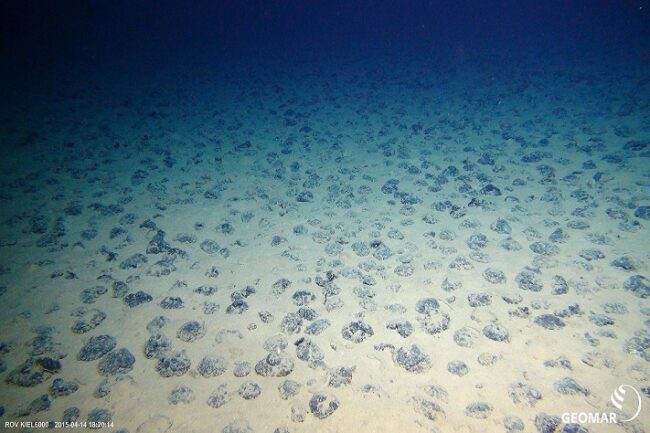
    Polymetallic nodules in the Clarion-Clipperton Zone in the Pacific Ocean. Source: ROV KIEL 6000, GEOMAR

    Facebook Twitter LinkedIn Email

    In 2024, a study published in Nature Geoscience garnered significant attention from both the scientific community and international media.

    Evidence of dark oxygen production at the abyssal seafloor was published in Nature Geoscience by an international team of researchers led by Dr. Andrew Sweetman at The Scottish Association for Marine Science. Their research was based on several cruises in the Pacific Ocean’s Clarion-Clipperton Zone (CCZ).

    In their research communiqué, the team proposed that polymetallic nodules on the seafloor may create currents strong enough to produce oxygen by splitting water molecules through a process known as electrolysis. The term “dark oxygen” refers to the production of oxygen in an environment where photosynthesis is not possible (the abyssal sea floor is pitch black).

    The process would require a previously unrecognized energy source and could according to the authors have far-reaching implications for ocean chemistry and even theories about life on Earth and other planets.

    However, the claim has remained unreplicated and widely debated.

    At Seabed Minerals 2026 in Bergen (24–26 March), Environmental Scientist Patrick Downes of The Metals Company will present a published critique evaluating the original study.

    The review highlights three main concerns: inconsistency with comparable benthic chamber studies, lack of a viable energy source to drive electrolysis, and evidence from control experiments suggesting the oxygen signal may originate from the measurement system itself rather than from the nodules.

    Multiple independent studies from nodule-bearing regions in the Pacific report only oxygen consumption, consistent with global abyssal averages. In addition, the voltages measured across nodule surfaces fall well below what is required to split water under laboratory conditions. Furthermore, hydrogen, a necessary by-product of electrolysis, was not reported.
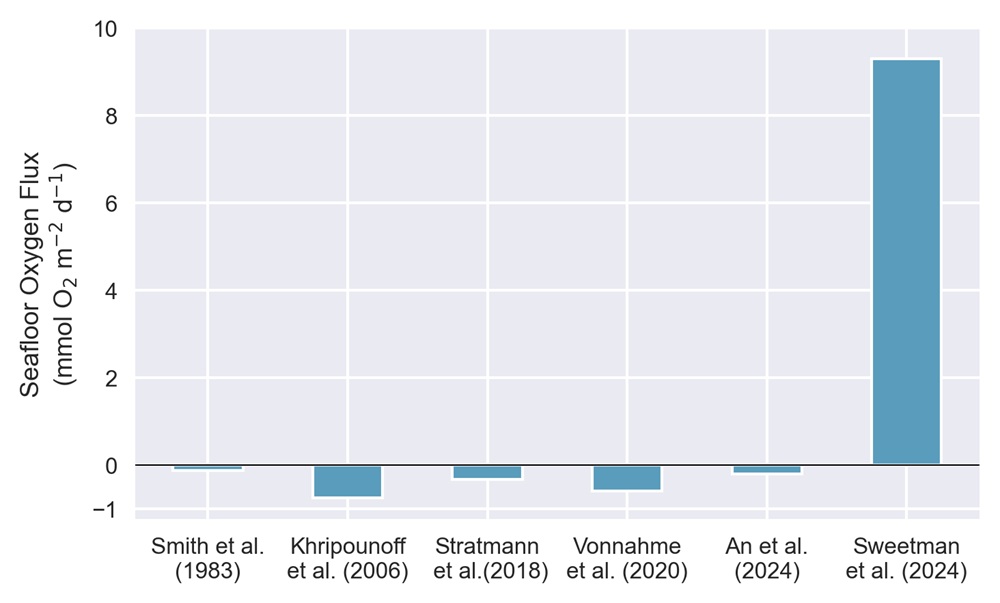
    Comparison of seafloor oxygen fluxes measured in situ using benthic chamber landers deployed in polymetallic nodule-rich areas. Illustration courtesy of Patrick Downes (Downes et al., 2025) / conference abstract

    The presentation will examine whether the reported dark oxygen signal reflects a genuine geochemical process or an experimental artefact — a question with significant implications for deep-sea science and seabed mineral research.

    Program and registration details are available on the conference website.

    Related Posts

    Ny vurdering av det ukjente

    juni 7, 2026

    Knytter mineralfunn til Framstredets åpning

    juni 2, 2026

    Demonstrerte mulighetene – satt på pause

    mars 25, 2026
    Add A Comment

    Comments are closed.

    NYHETSBREV
    Abonner på vårt nyhetsbrev
    geo365.no: ledende leverandør av nyheter og kunnskap som vedrører geofaget og geofaglige problemstillinger relatert til norsk samfunnsliv og næringsliv.
    KONFERANSER

    Pedagogisk glød og kakebaking ga undervisningspris
    Jun 11, 2026

    Pedagogisk glød og kakebaking ga undervisningspris

    Tidlig oljeutdrivning i Nordsjøen
    Jun 08, 2026

    Tidlig oljeutdrivning i Nordsjøen

    En sårbar situasjon for Longyearbyens drikkevann
    Jun 04, 2026

    En sårbar situasjon for Longyearbyens drikkevann

    NGU i toppsjiktet
    Jun 01, 2026

    NGU i toppsjiktet

    Ser litiumpotensial på norsk sokkel
    May 28, 2026

    Ser litiumpotensial på norsk sokkel

    Subsurface noise #8
    Jun 12, 2026

    Subsurface noise #8

    Serendipity maximisation
    Jun 11, 2026

    Serendipity maximisation

    Hybrid terrain, unified technology – GT’s land‑nodal system for high‑quality transition zone seismic data acquisition
    Jun 10, 2026

    Hybrid terrain, unified technology – GT’s land‑nodal system for high‑quality transition zone seismic data acquisition

    “Running a company is like having a long-term relationship – you have to give and take, but always carry on”
    Jun 10, 2026

    “Running a company is like having a long-term relationship – you have to give and take, but always carry on”

    A Cenomanian- Turonian source rock adventure in the Pelotas Basin
    Jun 09, 2026

    A Cenomanian- Turonian source rock adventure in the Pelotas Basin

    OLJEPRIS
    BCOUSD quotes by TradingView
    GULLPRIS
    GOLD quotes by TradingView
    KOBBERPRIS
    Track all markets on TradingView
    GeoPublishing AS

    GeoPublishing AS
    Trollkleiva 23
    N-1389 Heggedal

    Publisher & General Manager

    Ingvild Ryggen Carstens
    ingvild@geopublishing.no
    cell: +47 974 69 090

    Editor in Chief

    Ronny Setså
    ronny@geopublishing.no
    +47 901 08 659

    Media Guide

    Download Media Guide

    ABONNEMENT
    NYHETSBREV
    Abonner på vårt nyhetsbrev
    © 2026 GeoPublishing AS - All rights reserved.

    Type above and press Enter to search. Press Esc to cancel.