Close Menu
    Facebook LinkedIn
    Geo365
    Facebook LinkedIn
    BESTILL Login ABONNÉR PÅ NYHETSBREV
    • Hjem
    • Anlegg og infrastruktur
    • Aktuelt
    • Bergindustri
    • Dyphavsmineraler
    • Miljø
    • Olje og gass
    • Geofunn
    • Download Media Guide
    Geo365
    You are at:Home » From workflow to agent
    Aktuelt

    From workflow to agent

    What happens when AI moves beyond executing predefined workflows and starts deciding what to do next? Cegal will demonstrate how agent-based approaches could reshape structural uncertainty analysis at Dig X Subsurface 2026.
    By Redaksjonenoktober 22, 2026
    Del denne artikkelen Facebook Twitter LinkedIn Email

    Illustration modified from Cegal / conference abstract

    Facebook Twitter LinkedIn Email

    Automation has become commonplace in subsurface workflows, helping geoscientists process larger datasets and run increasingly complex analyses. Yet most automated workflows still follow a predefined sequence of steps, regardless of what the results reveal.

    At the Dig X Subsurface 2026 conference in Lillestrøm, Umedzhon Kakhkhorov, Senior Software Analyst Geoscience at Cegal, will present how structural uncertainty analysis in Petrel could evolve from workflow automation towards more agentic geoscience.

    The distinction is important. Traditional workflows follow predefined steps, while agents can dynamically select tools and calculations based on intermediate results, within boundaries set by the geoscientist.

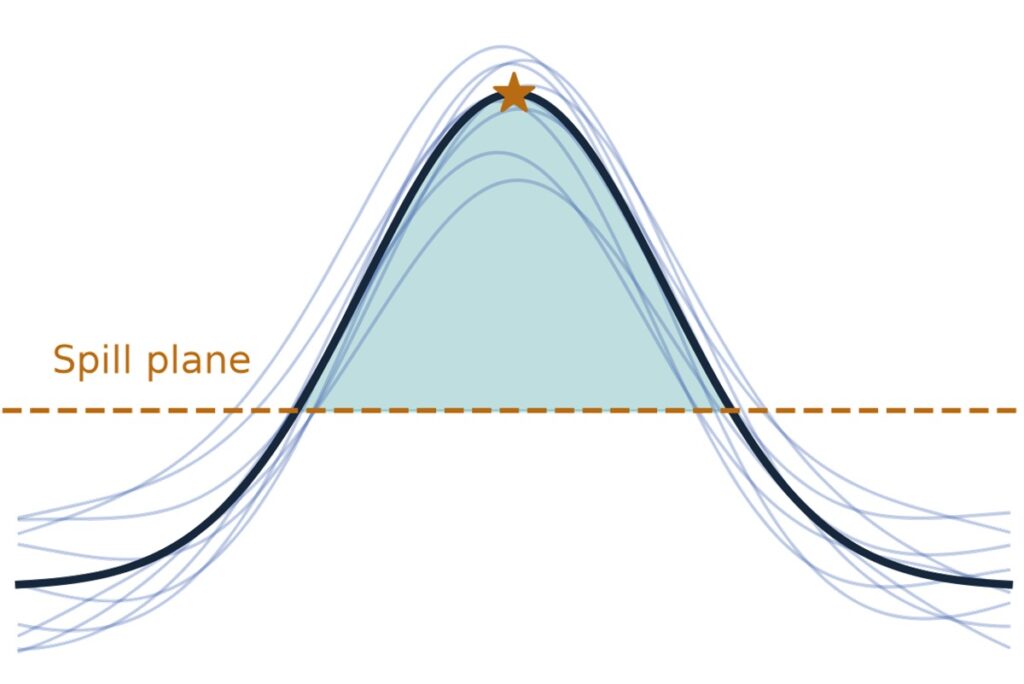
    Kakhkhorov’s presentation uses the Volve field as an example of how structural uncertainty can be assessed through ensemble modelling. By generating multiple depth-map realizations from different velocity scenarios, geoscientists can better understand how uncertainty affects closure size and volume estimates.

    Instead of relying on a single depth interpretation, the resulting ensemble can be used to calculate closure probability and estimate P10, P50 and P90 volumes, helping teams assess prospect uncertainty before drilling.

    Using Python integration, calculations can be run directly against Petrel project data without manual export and import steps.
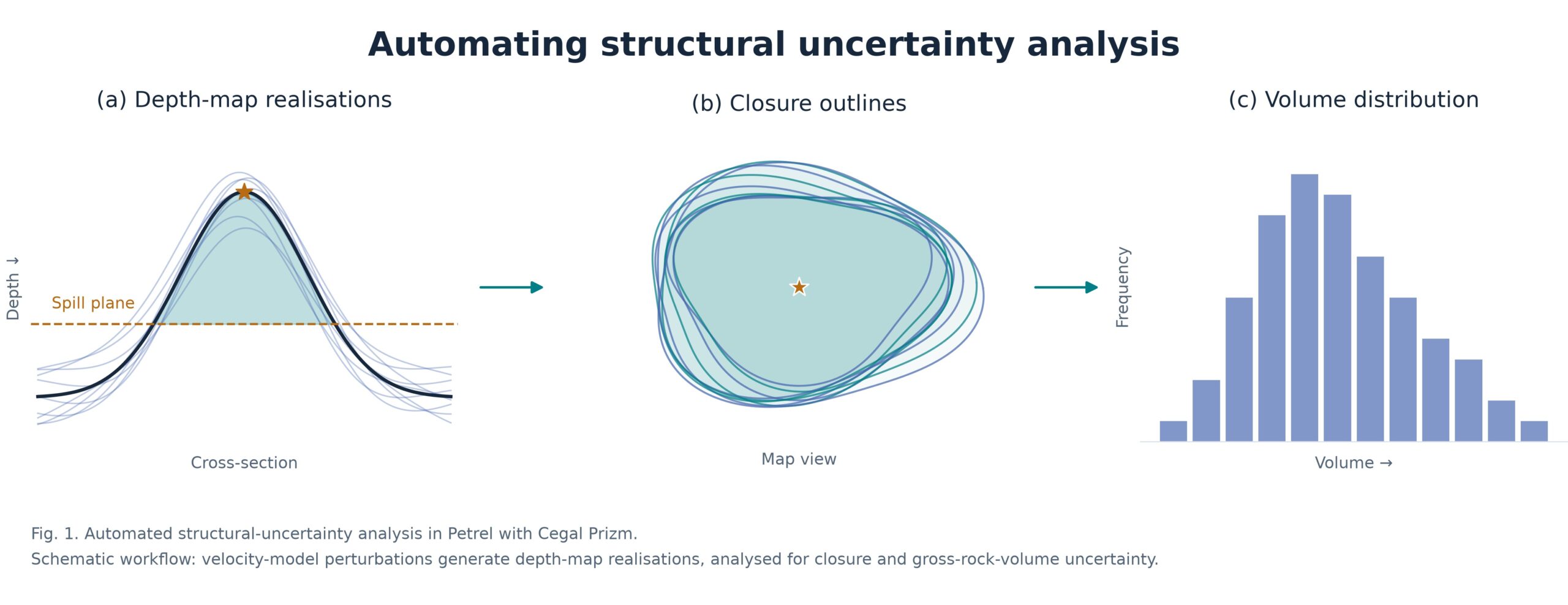
    Example of structural uncertainty analysis performed in Petrel using the Volve dataset. Illustration: Cegal / conference abstract

    The next step, according to Cegal, is to allow language models to use these tools more autonomously. Rather than simply executing a predefined workflow, an agent could compare velocity scenarios, determine whether additional realizations are needed and recommend the next analytical step.

    The geoscientist would still define the geological assumptions, quality controls and stopping criteria, while the agent assists with organizing calculations and synthesizing the results.

    Although the current implementation focuses on automated ensemble calculations, the work offers a glimpse of how agent-based systems could eventually become part of everyday subsurface interpretation workflows.

    Join us in Lillestrøm on December 2-3 to learn more about how Cegal is exploring the transition from workflow-based automation to agent-guided geoscience. The presentation is part of Dig X Subsurface 2026, a conference dedicated to digital workflows, data and AI in subsurface geoscience. The program can be found on the conference website.

    Related Posts

    Norske fjorder, sølv og marmor får internasjonal anerkjennelse

    november 19, 2026

    From conversation to simulation

    november 17, 2026

    Liberating Troll’s hidden data

    november 11, 2026
    Add A Comment
    Leave A Reply Cancel Reply

    NYHETSBREV
    Abonner på vårt nyhetsbrev
    geo365.no: ledende leverandør av nyheter og kunnskap som vedrører geofaget og geofaglige problemstillinger relatert til norsk samfunnsliv og næringsliv.
    KONFERANSER

    Lekker hundrevis av liter olje hver dag
    Nov 20, 2026

    Lekker hundrevis av liter olje hver dag

    From workflow to agent
    Nov 20, 2026

    From workflow to agent

    Steinsprang i Longyearbyen registrert med fiberoptisk teknologi
    Nov 17, 2026

    Steinsprang i Longyearbyen registrert med fiberoptisk teknologi

    Skred i Kvam registrert i Sverige
    Nov 13, 2026

    Skred i Kvam registrert i Sverige

    Norske fjorder, sølv og marmor får internasjonal anerkjennelse
    Nov 10, 2026

    Norske fjorder, sølv og marmor får internasjonal anerkjennelse

    Is the oil industry cannibalising itself in geoscience recruitment?
    Nov 20, 2026

    Is the oil industry cannibalising itself in geoscience recruitment?

    A tale of a cave or how much in-place volume you might be missing
    Nov 19, 2026

    A tale of a cave or how much in-place volume you might be missing

    Polymetallic nodule discovery onshore Peru
    Nov 18, 2026

    Polymetallic nodule discovery onshore Peru

    A jump in the deep
    Nov 17, 2026

    A jump in the deep

    It boils down to connectivity
    Nov 16, 2026

    It boils down to connectivity

    OLJEPRIS
    BCOUSD quotes by TradingView
    GULLPRIS
    GOLD quotes by TradingView
    KOBBERPRIS
    Track all markets on TradingView
    GeoPublishing AS

    GeoPublishing AS
    Trollkleiva 23
    N-1389 Heggedal

    Publisher & General Manager

    Ingvild Ryggen Carstens
    ingvild@geopublishing.no
    cell: +47 974 69 090

    Editor in Chief

    Ronny Setså
    ronny@geopublishing.no
    +47 901 08 659

    Media Guide

    Download Media Guide

    ABONNEMENT
    NYHETSBREV
    Abonner på vårt nyhetsbrev
    © 2026 GeoPublishing AS - All rights reserved.

    Type above and press Enter to search. Press Esc to cancel.