Close Menu
    Facebook LinkedIn
    Geo365
    Facebook LinkedIn
    BESTILL Login ABONNÉR PÅ NYHETSBREV
    • Hjem
    • Anlegg og infrastruktur
    • Aktuelt
    • Bergindustri
    • Dyphavsmineraler
    • Miljø
    • Olje og gass
    • Geofunn
    • Download Media Guide
    Geo365
    You are at:Home » Machine-assisted Hunt for Hydrocarbons
    Olje og gass

    Machine-assisted Hunt for Hydrocarbons

    By Redaksjonenmars 5, 2024
    Del denne artikkelen Facebook Twitter LinkedIn Email
    THIS WEEK: We are welcoming two presenters to our session on petroleum system analysis. Join the Dig X Subsurface conference to learn how machines may help us understand how oil and gas have formed, moved, and accumulated underground.

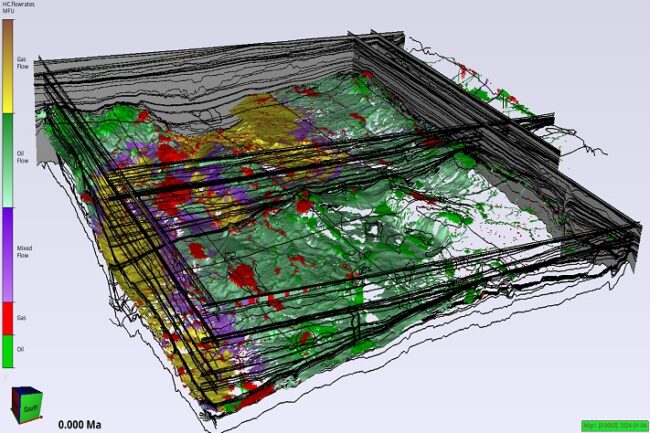
    Complex charge of Jurassic and Cretaceous carriers within Quadrant 35 in the Northern North Sea (time step from 2 to 0 Ma). Black lines show layer boundaries from the seabed down to the Triassic. Green colors show oil migration and trapping. Yellow and red colors represent gas migration and trapping while blue colors show areas with mixed oil and gas migration. Image courtesy of Øyvind Sylta / Migris

    Facebook Twitter LinkedIn Email

    We are rounding off the Dig X Subsurface 2024 conference with a session within a session, focusing on Petroleum System Analysis. The method is widely used to assess the potential for finding and extracting oil and gas, utilizing geological, geophysical, and geochemical data to understand how hydrocarbons are formed, transported, and trapped in the subsurface.

    Francois Gelin (TotalEnergies) is presenting two projects in cooperation with Earth Science Analytics, where the overall purpose has been to constrain basin models, particularly the thermal history. In short, machine learning has been utilized to estimate maturity based on predictions of two indicators (palynomorph darkness index and vitrinite reflectance).

    In combination, the two projects document a wide variety of methods for extracting quantitative data and insight from images, and it has been possible to set up positive feedback loops in terms of quality control and results improvements between the projects.

    Øyvind Sylta (Migris) will highlight a new workflow for automating seismic interpretations and petroleum system modeling studies, using a data set from the Q35 in the North Sea.

    Generating more data than previous methods, Sylta will explain how the workflow may allow for more detailed exploration interpretations and risk assessments – and ultimately contribute to developing new prospect and play models. Possible challenges will also be shared.

    The program can be found on the conference website. The place is Oslo (Gardermoen) and the dates are March 5 – 6th 2024.

    Related Posts

    Mange år (og fat) gjenstår

    mars 18, 2026

    Fant mer olje i Tubåen

    mars 18, 2026

    Tempoet må opp

    mars 16, 2026
    Add A Comment

    Comments are closed.

    NYHETSBREV
    Abonner på vårt nyhetsbrev
    geo365.no: ledende leverandør av nyheter og kunnskap som vedrører geofaget og geofaglige problemstillinger relatert til norsk samfunnsliv og næringsliv.
    KONFERANSER

    Knytter mineralfunn til Framstredets åpning
    Mar 31, 2026

    Knytter mineralfunn til Framstredets åpning

    Asteroidenedslag: Mjølnirkrateret
    Mar 30, 2026

    Asteroidenedslag: Mjølnirkrateret

    Zero-waste processing of deep-sea minerals
    Mar 24, 2026

    Zero-waste processing of deep-sea minerals

    Seabed mining – life recovers
    Mar 20, 2026

    Seabed mining – life recovers

    Havet endret seg brått rundt 1950 
    Mar 18, 2026

    Havet endret seg brått rundt 1950 

    First seabed copper from Norway
    Apr 03, 2026

    First seabed copper from Norway

    Offshore Algarve Basin geological carbon storage potential
    Apr 02, 2026

    Offshore Algarve Basin geological carbon storage potential

    From the shores of Lake Geneva to NEOM in Saudi
    Apr 01, 2026

    From the shores of Lake Geneva to NEOM in Saudi

    Grand plans, challenging geology
    Mar 31, 2026

    Grand plans, challenging geology

    How to generate an oil accumulation in a gas-prone petroleum system?
    Mar 30, 2026

    How to generate an oil accumulation in a gas-prone petroleum system?

    OLJEPRIS
    BCOUSD quotes by TradingView
    GULLPRIS
    GOLD quotes by TradingView
    KOBBERPRIS
    Track all markets on TradingView
    GeoPublishing AS

    GeoPublishing AS
    Trollkleiva 23
    N-1389 Heggedal

    Publisher & General Manager

    Ingvild Ryggen Carstens
    ingvild@geopublishing.no
    cell: +47 974 69 090

    Editor in Chief

    Ronny Setså
    ronny@geopublishing.no
    +47 901 08 659

    Media Guide

    Download Media Guide

    ABONNEMENT
    NYHETSBREV
    Abonner på vårt nyhetsbrev
    © 2026 GeoPublishing AS - All rights reserved.

    Type above and press Enter to search. Press Esc to cancel.