
Close Menu
    Facebook LinkedIn
    Geo365
    Facebook LinkedIn
    BESTILL Login ABONNÉR PÅ NYHETSBREV
    • Hjem
    • Anlegg og infrastruktur
    • Aktuelt
    • Bergindustri
    • Dyphavsmineraler
    • Miljø
    • Olje og gass
    • Geofunn
    • Download Media Guide
    Geo365
    You are at:Home » Teaching AI geology
    Aktuelt

    Teaching AI geology

    Can AI make better reservoir predictions if it understands geological context? RagnaRock Geo will show how stratigraphy-guided AI improved blind-well predictions in a complex offshore field at Dig X Subsurface 2026.
    By Redaksjonennovember 4, 2026
    Del denne artikkelen Facebook Twitter LinkedIn Email
    OLYMPUS DIGITAL CAMERA

    Åsmund Heir, CEO of RagnaRock Geo, will present the company's stratigraphy-guided AI workflow for reservoir characterization at Dig X Subsurface 2026. Photo: RagnaRock Geo

    Facebook Twitter LinkedIn Email

    Reservoir characterization in geologically complex fields is rarely straightforward. Conventional seismic inversion remains a powerful tool, but the results can be sensitive to assumptions related to wavelets, low-frequency models and other processing parameters.

    At the Dig X Subsurface 2026 conference in Lillestrøm in December, Åsmund Heir, CEO of RagnaRock Geo, will present an AI-based workflow designed to improve reservoir characterization by giving machine-learning models a better understanding of geological context.

    The case study focuses on the Poseidon gas field in Australia’s Browse Basin. Rather than relying solely on seismic data, the workflow combines seismic volumes, well logs, interpreted horizons, stratigraphic units, and Relative Geologic Time (RGT) volumes. Together, these inputs help the model account for geological context, not just seismic signatures.

    According to the authors, this additional stratigraphic context can significantly improve prediction quality. In blind-well tests, where a well is excluded from model training, the approach achieved correlations exceeding 80 percent. In one key experiment, adding geological information improved the correlation from approximately 70 to 81 percent while halving the prediction error.

    The workflow was used to predict acoustic impedance, porosity, and gamma-ray values across the reservoir. The results reproduced key geological trends between wells and identified reservoir features that were less evident in previously published inversion results.

    Just as importantly, the workflow delivers results quickly. Once the data have been prepared, training and prediction take less than a minute. The authors note, however, that geological quality control and data conditioning remain essential parts of the process.

    Rather than replacing conventional seismic inversion, RagnaRock Geo sees the technology as a complementary tool. Comparing AI predictions with physics-based inversion results may help interpreters identify areas that warrant further investigation and reduce uncertainty in complex reservoirs.

    Join us in Lillestrøm on December 2-3 to learn more about how geological knowledge can be combined with artificial intelligence to improve reservoir characterization. The program can be found on the conference website.
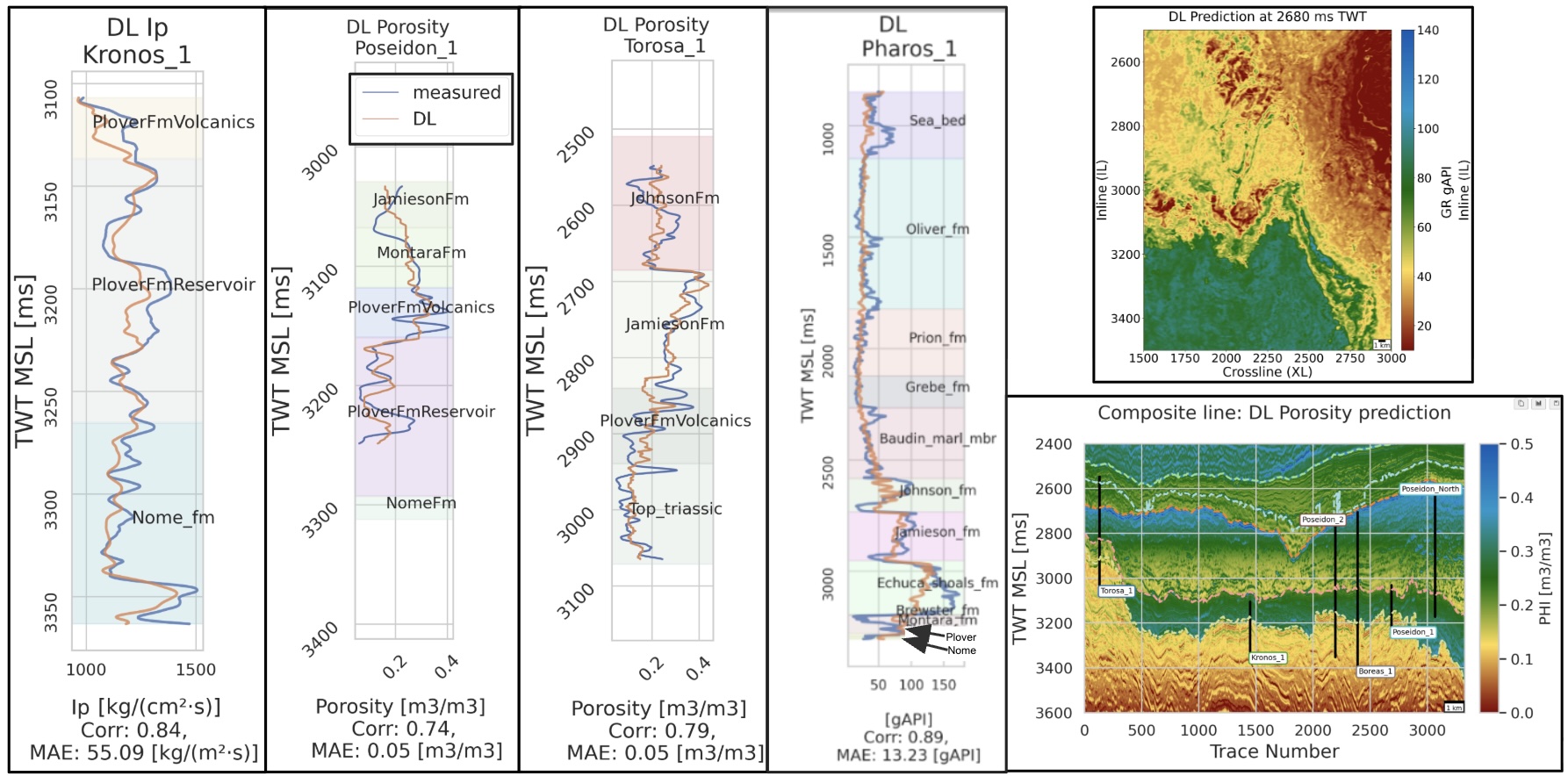
    Blind-well testing in the Poseidon field showed that adding stratigraphic context improved acoustic-impedance prediction accuracy, increasing correlation from 70 to 81 percent. Illustration: RagnaRock Geo / conference abstract

    Related Posts

    Visual quality control for reservoir models

    november 24, 2026

    Norske fjorder, sølv og marmor får internasjonal anerkjennelse

    november 19, 2026

    From conversation to simulation

    november 17, 2026
    Add A Comment
    Leave A Reply Cancel Reply

    NYHETSBREV
    Abonner på vårt nyhetsbrev
    geo365.no: ledende leverandør av nyheter og kunnskap som vedrører geofaget og geofaglige problemstillinger relatert til norsk samfunnsliv og næringsliv.
    KONFERANSER

    Lekker hundrevis av liter olje hver dag
    Nov 20, 2026

    Lekker hundrevis av liter olje hver dag

    From workflow to agent
    Nov 20, 2026

    From workflow to agent

    Steinsprang i Longyearbyen registrert med fiberoptisk teknologi
    Nov 17, 2026

    Steinsprang i Longyearbyen registrert med fiberoptisk teknologi

    Skred i Kvam registrert i Sverige
    Nov 13, 2026

    Skred i Kvam registrert i Sverige

    Norske fjorder, sølv og marmor får internasjonal anerkjennelse
    Nov 10, 2026

    Norske fjorder, sølv og marmor får internasjonal anerkjennelse

    From hydraulic jumps to Goldilocks zones
    Nov 24, 2026

    From hydraulic jumps to Goldilocks zones

    “I don’t want dry holes, and I only want big prospects”
    Nov 23, 2026

    “I don’t want dry holes, and I only want big prospects”

    Is the oil industry cannibalising itself in geoscience recruitment?
    Nov 20, 2026

    Is the oil industry cannibalising itself in geoscience recruitment?

    A tale of a cave or how much in-place volume you might be missing
    Nov 19, 2026

    A tale of a cave or how much in-place volume you might be missing

    Polymetallic nodule discovery onshore Peru
    Nov 18, 2026

    Polymetallic nodule discovery onshore Peru

    OLJEPRIS
    BCOUSD quotes by TradingView
    GULLPRIS
    GOLD quotes by TradingView
    KOBBERPRIS
    Track all markets on TradingView
    GeoPublishing AS

    GeoPublishing AS
    Trollkleiva 23
    N-1389 Heggedal

    Publisher & General Manager

    Ingvild Ryggen Carstens
    ingvild@geopublishing.no
    cell: +47 974 69 090

    Editor in Chief

    Ronny Setså
    ronny@geopublishing.no
    +47 901 08 659

    Media Guide

    Download Media Guide

    ABONNEMENT
    NYHETSBREV
    Abonner på vårt nyhetsbrev
    © 2026 GeoPublishing AS - All rights reserved.

    Type above and press Enter to search. Press Esc to cancel.