Close Menu
    Facebook LinkedIn
    Geo365
    Facebook LinkedIn
    BESTILL Login ABONNÉR PÅ NYHETSBREV
    • Hjem
    • Anlegg og infrastruktur
    • Aktuelt
    • Bergindustri
    • Dyphavsmineraler
    • Miljø
    • Olje og gass
    • Geofunn
    • Download Media Guide
    Geo365
    You are at:Home » Understanding the fate of sulfide metals
    Dyphavsmineraler

    Understanding the fate of sulfide metals

    As seafloor sulfide deposits age and disintegrate, copper and other valuable metals can be washed away or concentrated in different layers. Two key minerals may serve as clues for finding the untapped resources.
    By Ronny Setsåmars 28, 2025
    Del denne artikkelen Facebook Twitter LinkedIn Email

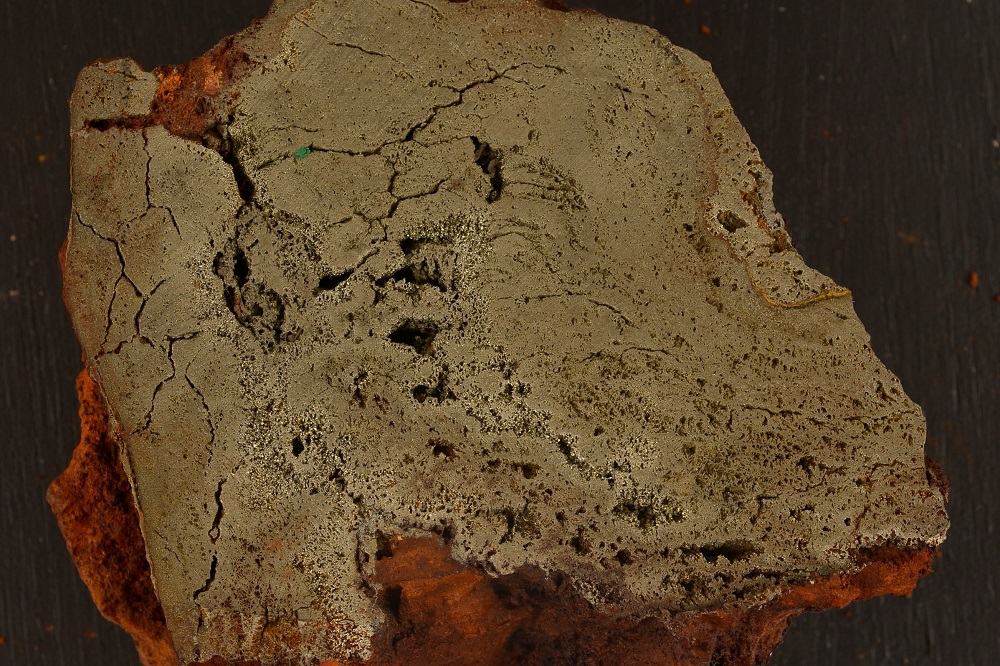
    Massive metallic sulfide collected during the project ULTRA expedition in 2022. Photo: Project ULTRA

    Facebook Twitter LinkedIn Email

    Seafloor massive sulfide (SMS) deposits are formed when boiling, mineral-rich hydrothermal fluids vent on the seabed, a process that usually occurs at spreading ridges.

    These sulfide deposits often contain substantial amounts of valuable metals, including copper, nickel, zinc, gold, and silver. Exploration companies target inactive vents to avoid the challenges posed by high-temperature fluids and to minimize disturbance to vulnerable marine fauna.

    However, as extinct SMS deposits age and interact with seawater, their composition changes—sometimes for the better and sometimes for the worse.

    How metals behave in aging sulfide deposits remains poorly understood.

    At the Deep Sea Minerals conference in Bergen in April, University of Southampton researcher Christian Star Bishop will share some insights into his team’s investigation at the Semenov hydrothermal field in the Atlantic Ocean. Semenov is considered to host the largest known sulfide deposits.

    The project participants conducted two research expeditions to the Mid-Atlantic spreading ridge in 2022 and 2023 and analyzed the collected samples in order to find out what happens to the sulfide metals over time.

    When sulfide minerals such as pyrite and chalcopyrite are exposed to oxygen and seawater, they break down into new minerals. These new minerals, including atacamite and iron oxyhydroxide (Fe-oxyhydroxide), act like sponges, absorbing copper and zinc.

    Atacamite collected at the site contained an average of 2.87 wt.% copper, while Fe-oxyhydroxide held 1.38 wt.%.

    The lab studies revealed that the type of sulfide material influences the retention of metals. Specifically, Fe-oxyhydroxide derived from chalcopyrite retains more copper, while pyrite-derived forms tend to hold more zinc.

    However, as sulfide deposits age and undergo further oxidation, they appear to lose a significant amount of their copper and zinc. Fe-oxyhydroxide precipitates as ferrihydrite, which can later crystallize into goethite. This transformation results in the release of approximately 92% of the copper and 57% of the zinc originally contained in the Fe-oxyhydroxide.
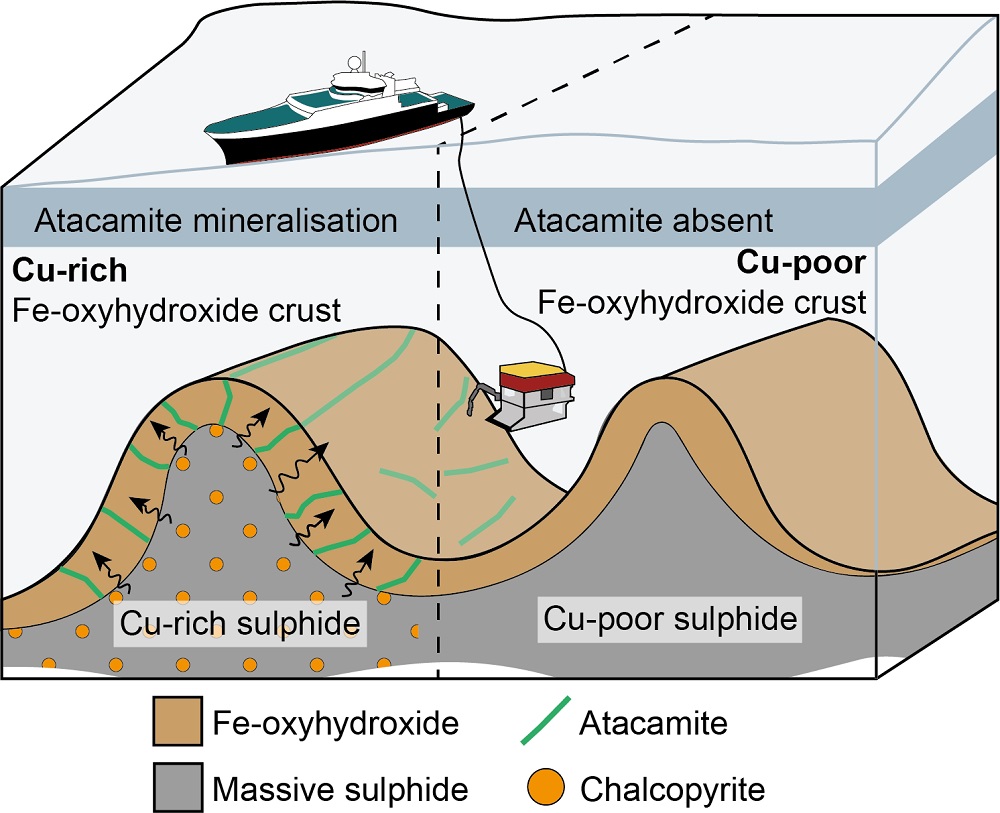
    The presence of atacamite may be a good indicator of a deeper copper-rich sulfide deposit. Figure: Bishop et al., 2025 (conference abstract)

    As a result, it is likely that older, off-axis deposits are considerably depleted of these metals due to the prolonged processes of oxidation and goethite formation.

    SMS deposits may also be rich in gold and silver. The project results indicate that the precious metals behave differently during weathering. Instead of being absorbed into Fe-oxyhydroxide, they are either lost in seawater or concentrated in specific zones known as redox fronts at the margins of sulfide deposits.

    This suggests that areas with enriched gold and silver within partially weathered sulfide could serve as promising targets for future exploration.

    The results from the study may help to guide future exploration of SMS deposits through an enhanced understanding of the mobility and behavior of metals. Fe-oxyhydroxide and atacamite could serve as valuable clues, highlighting areas with the greatest copper concentration in sulfide weathering products and underlying massive sulfides.

    Deep Sea Minerals 2025 will take place in Bergen from 1-3 April. The program and registration page can be found on the conference website.

    Related Posts

    Ny vurdering av det ukjente

    juni 7, 2026

    Knytter mineralfunn til Framstredets åpning

    juni 2, 2026

    Demonstrerte mulighetene – satt på pause

    mars 25, 2026
    Add A Comment

    Comments are closed.

    NYHETSBREV
    Abonner på vårt nyhetsbrev
    geo365.no: ledende leverandør av nyheter og kunnskap som vedrører geofaget og geofaglige problemstillinger relatert til norsk samfunnsliv og næringsliv.
    KONFERANSER

    Pedagogisk glød og kakebaking ga undervisningspris
    Jun 11, 2026

    Pedagogisk glød og kakebaking ga undervisningspris

    Tidlig oljeutdrivning i Nordsjøen
    Jun 08, 2026

    Tidlig oljeutdrivning i Nordsjøen

    En sårbar situasjon for Longyearbyens drikkevann
    Jun 04, 2026

    En sårbar situasjon for Longyearbyens drikkevann

    NGU i toppsjiktet
    Jun 01, 2026

    NGU i toppsjiktet

    Ser litiumpotensial på norsk sokkel
    May 28, 2026

    Ser litiumpotensial på norsk sokkel

    Subsurface noise #8
    Jun 12, 2026

    Subsurface noise #8

    Serendipity maximisation
    Jun 11, 2026

    Serendipity maximisation

    Hybrid terrain, unified technology – GT’s land‑nodal system for high‑quality transition zone seismic data acquisition
    Jun 10, 2026

    Hybrid terrain, unified technology – GT’s land‑nodal system for high‑quality transition zone seismic data acquisition

    “Running a company is like having a long-term relationship – you have to give and take, but always carry on”
    Jun 10, 2026

    “Running a company is like having a long-term relationship – you have to give and take, but always carry on”

    A Cenomanian- Turonian source rock adventure in the Pelotas Basin
    Jun 09, 2026

    A Cenomanian- Turonian source rock adventure in the Pelotas Basin

    OLJEPRIS
    BCOUSD quotes by TradingView
    GULLPRIS
    GOLD quotes by TradingView
    KOBBERPRIS
    Track all markets on TradingView
    GeoPublishing AS

    GeoPublishing AS
    Trollkleiva 23
    N-1389 Heggedal

    Publisher & General Manager

    Ingvild Ryggen Carstens
    ingvild@geopublishing.no
    cell: +47 974 69 090

    Editor in Chief

    Ronny Setså
    ronny@geopublishing.no
    +47 901 08 659

    Media Guide

    Download Media Guide

    ABONNEMENT
    NYHETSBREV
    Abonner på vårt nyhetsbrev
    © 2026 GeoPublishing AS - All rights reserved.

    Type above and press Enter to search. Press Esc to cancel.