Close Menu
    Facebook LinkedIn
    Geo365
    Facebook LinkedIn
    BESTILL Login ABONNÉR PÅ NYHETSBREV
    • Hjem
    • Anlegg og infrastruktur
    • Aktuelt
    • Bergindustri
    • Dyphavsmineraler
    • Miljø
    • Olje og gass
    • Geofunn
    • Download Media Guide
    Geo365
    You are at:Home » The world’s largest SMS deposits
    Dyphavsmineraler

    The world’s largest SMS deposits

    A team of scientists has discovered a cluster of large sulfide deposits along the Mid-Atlantic Ridge and offers insight into how they came to be and where else to look for them.
    By Ronny Setsåmars 20, 2025
    Del denne artikkelen Facebook Twitter LinkedIn Email

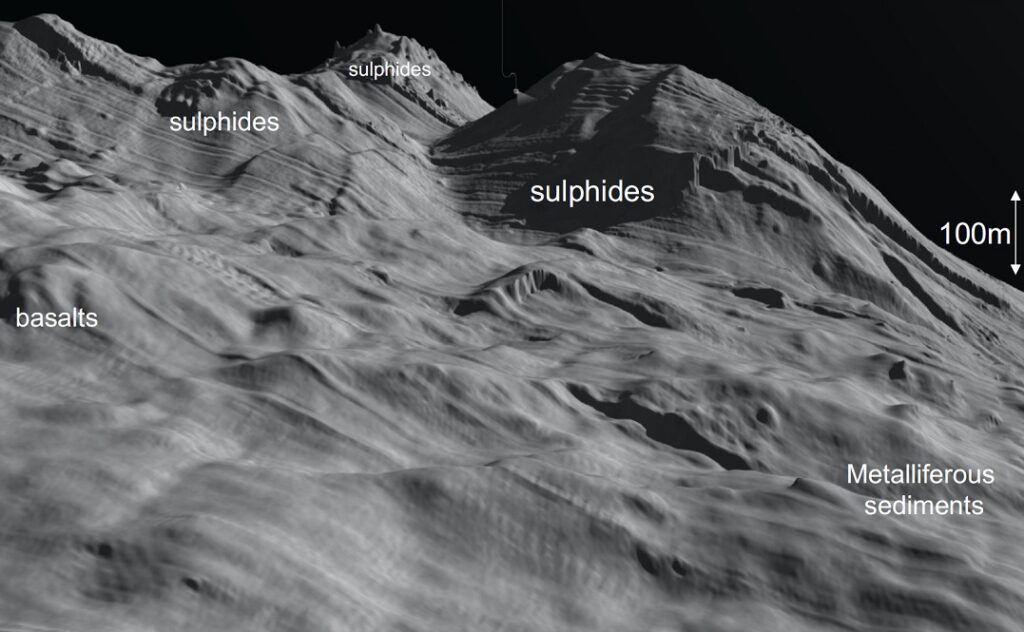
    Perspective view of the SMS mounds at Semenov 4 hydrothermal field, located on the Mid-Atlantic Ridge. The mounds are estimated to contain more than 100 million tonnes of sulfides. Source: Murton et al., 2025 (conference abstract)

    Facebook Twitter LinkedIn Email

    Researchers have identified several mounds on the seafloor at approximately 13°N along the Mid-Atlantic Ridge, which is at a latitude similar to that of Senegal and Nicaragua. These mounds represent the largest known deposits of seafloor massive sulfides (SMS).

    The mounds measure up to 300 meters in height and almost half a kilometer in width. Initial estimates suggest they contain at least 100 million tonnes of sulfide.

    For comparison, the SMS deposit Mohn’s Treasure, located on the Mohn’s Ridge, is believed to contain about 2.2 million tonnes of sulfide ore, according to the Norwegian Offshore Directorate.

    These mounds are part of the Semenov hydrothermal field cluster, which has been regularly visited by researchers involved in the ULTRA project.

    The project members have collected a variety of data from the sites, using high resolution seafloor mapping, remotely operated vehicles, seafloor drilling, sediment coring, sub-seafloor imaging by seismic reflection and refraction, and sub-seafloor resistivity surveys using controlled source electromagnetics.

    At the Deep Sea Minerals conference in Bergen in April, project leader Bramley Murton from the National Oceanography Centre will present the latest findings from ULTRA, based on investigations conducted at six sites.

    Mantle exposed at the seabed

    The researchers propose that the vast amounts of accumulated sulfide material can be explained by the presence of an oceanic core complex (OCC). OCCs form on the flanks of mid-ocean ridges where detachment faulting exposes ultramafic rocks (mantle rocks) at the seabed.

    The study suggests that detachment faulting creates ideal conditions for large SMS deposits by sustaining geothermal activity, maintaining high temperatures, and keeping fluid pathways open. These processes make OCCs promising targets for future deep-sea mineral exploration.

    OCC formation is common at slow-spreading ridges, such as the Mohn’s Ridge, suggesting excellent potential for sulfide deposits in the Norwegian exclusive economic zone.

    Norwegian participants in Project ULTRA are the University of Bergen, Equinor, and Green Minerals. Other partners include the National Oceanography Centre, the British Geological Survey, the universities of Cardiff, Southampton, Leeds, and the Memorial University (Canada), as well as GEOMAR (Germany).

    Deep Sea Minerals 2025 will take place in Bergen from 1-3 April. The program and registration page can be found on the conference website.

    Related Posts

    Industrieventyret som glapp

    desember 22, 2025

    Kritiserer havbunnsmineral-stopp

    desember 19, 2025

    Første kobber fra det norske dyphavet

    desember 17, 2025
    Add A Comment

    Comments are closed.

    NYHETSBREV
    Abonner på vårt nyhetsbrev
    geo365.no: ledende leverandør av nyheter og kunnskap som vedrører geofaget og geofaglige problemstillinger relatert til norsk samfunnsliv og næringsliv.
    KONFERANSER

    En fremragende underviser
    Jan 22, 2026

    En fremragende underviser

    Nordisk pris til arktisk pionér
    Jan 18, 2026

    Nordisk pris til arktisk pionér

    Uvanlig høye radonnivåer funnet i Aurland 
    Jan 15, 2026

    Uvanlig høye radonnivåer funnet i Aurland 

    Finansiering til nye havbunnsmineralprosjekter
    Jan 12, 2026

    Finansiering til nye havbunnsmineralprosjekter

    Industrieventyret som glapp
    Jan 08, 2026

    Industrieventyret som glapp

    The absurdity of security… or… comfortable being uncomfortable
    Jan 23, 2026

    The absurdity of security… or… comfortable being uncomfortable

    France’s first stimulated natural hydrogen project
    Jan 22, 2026

    France’s first stimulated natural hydrogen project

    Will Greenland be the next oil hotspot?
    Jan 21, 2026

    Will Greenland be the next oil hotspot?

    From cuttings to clarity: AI unlocking the Norwegian Continental Shelf
    Jan 20, 2026

    From cuttings to clarity: AI unlocking the Norwegian Continental Shelf

    Exploration in the vast marine expanse of Oceania
    Jan 19, 2026

    Exploration in the vast marine expanse of Oceania

    OLJEPRIS
    BCOUSD quotes by TradingView
    GULLPRIS
    GOLD quotes by TradingView
    KOBBERPRIS
    Track all markets on TradingView
    GeoPublishing AS

    GeoPublishing AS
    Trollkleiva 23
    N-1389 Heggedal

    Publisher & General Manager

    Ingvild Ryggen Carstens
    ingvild@geopublishing.no
    cell: +47 974 69 090

    Editor in Chief

    Ronny Setså
    ronny@geopublishing.no
    +47 901 08 659

    Media Guide

    Download Media Guide

    ABONNEMENT
    NYHETSBREV
    Abonner på vårt nyhetsbrev
    © 2026 GeoPublishing AS - All rights reserved.

    Type above and press Enter to search. Press Esc to cancel.