Reservoir engineers often use large numbers of simulation scenarios to understand uncertainty, but the challenge is usually not the mathematics itself. Setting up, validating and managing hundreds of simulations can be time-consuming and resource-intensive.
At the Dig X Subsurface 2026 conference in Lillestrøm, Åsmund Hugo, CEO and Engineer at Svøpe, will demonstrate an AI-agent framework designed to reduce that operational overhead through natural-language interaction.
Rather than manually configuring every step, engineers can ask the system to generate alternative reservoir scenarios, test uncertainty, compare simulations with production data and return a range of possible outcomes from a single conversation. The goal is to make uncertainty analysis a more iterative and accessible part of everyday reservoir management.
Behind the interface, however, the workflow remains tightly controlled. According to Hugo, every request follows an interpret-validate-act sequence. AI is used to understand the engineer’s intent, while the actual calculations are performed by deterministic tools and existing reservoir simulators.
Validation plays a central role. Proposed simulation workflows are checked before execution, and compute costs are estimated before resources are committed. The system is designed to prevent invalid simulation designs, runaway spending and other risks associated with increasingly autonomous workflows.
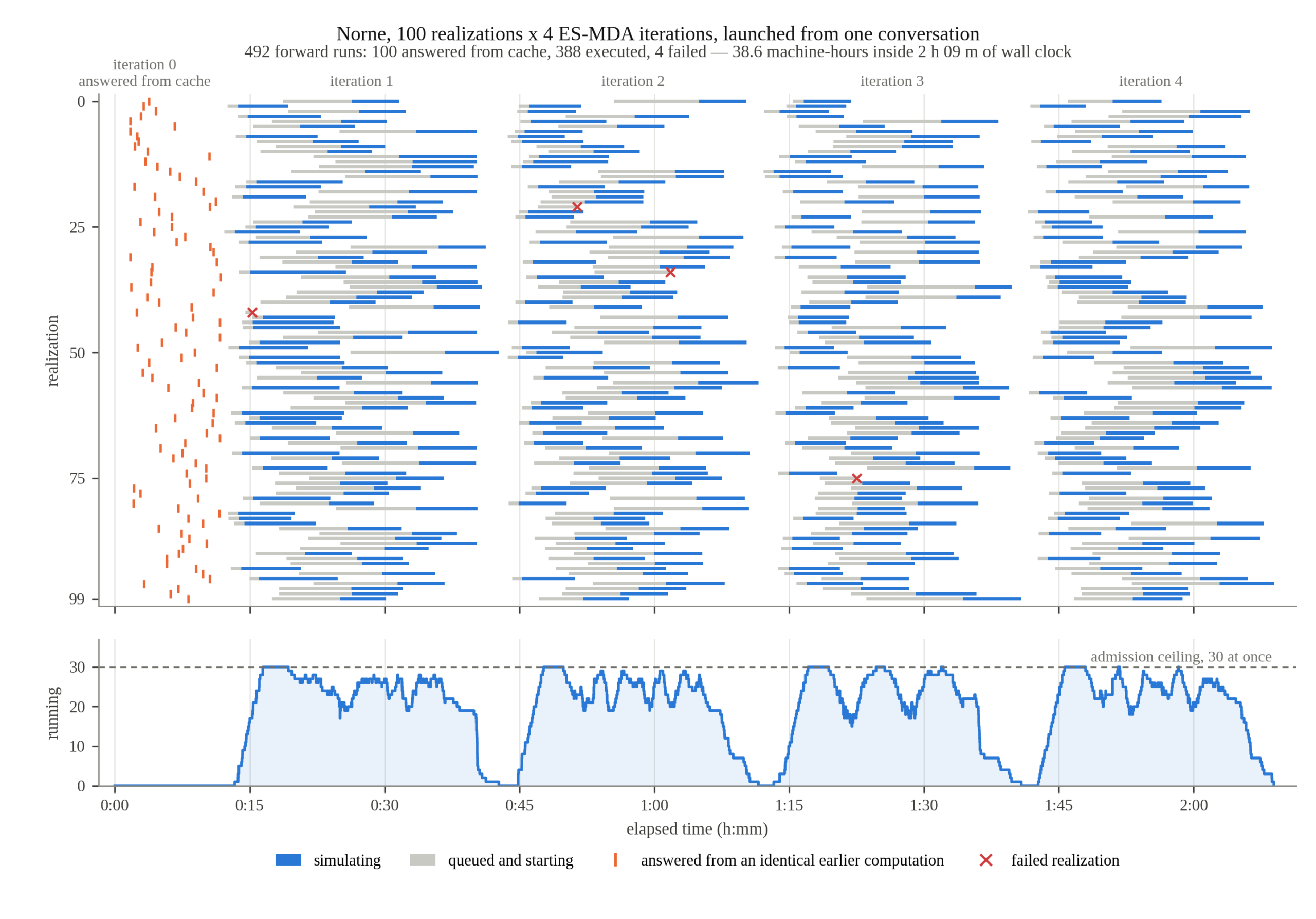
As an example, Hugo will present an uncertainty-analysis workflow based on a public benchmark derived from the Norne field, involving 100 reservoir simulation scenarios, all initiated through a single conversation. The workflow completed hundreds of simulations in just over two hours, automatically reusing previously computed results where possible and providing a cost estimate before execution.
The goal is not to automate engineering judgement. Whether the resulting model provides a geologically credible match to production data remains a decision for the reservoir engineer. Svøpe instead aims to remove much of the administrative and computational burden surrounding uncertainty workflows, allowing specialists to spend more time evaluating results and less time managing simulations.
As AI agents become increasingly common in the industry, the work also highlights the importance of governance, transparency and human oversight. Every action is recorded on an audit trail, spending limits can be enforced, and larger workflows require explicit approval before compute resources are committed.
Join us in Lillestrøm on December 2-3 to learn how AI agents could help transform ensemble-based reservoir workflows. The program can be found on the conference website.