Reservoir characterization in geologically complex fields is rarely straightforward. Conventional seismic inversion remains a powerful tool, but the results can be sensitive to assumptions related to wavelets, low-frequency models and other processing parameters.
At the Dig X Subsurface 2026 conference in Lillestrøm in December, Åsmund Heir, CEO of RagnaRock Geo, will present an AI-based workflow designed to improve reservoir characterization by giving machine-learning models a better understanding of geological context.
The case study focuses on the Poseidon gas field in Australia’s Browse Basin. Rather than relying solely on seismic data, the workflow combines seismic volumes, well logs, interpreted horizons, stratigraphic units, and Relative Geologic Time (RGT) volumes. Together, these inputs help the model account for geological context, not just seismic signatures.
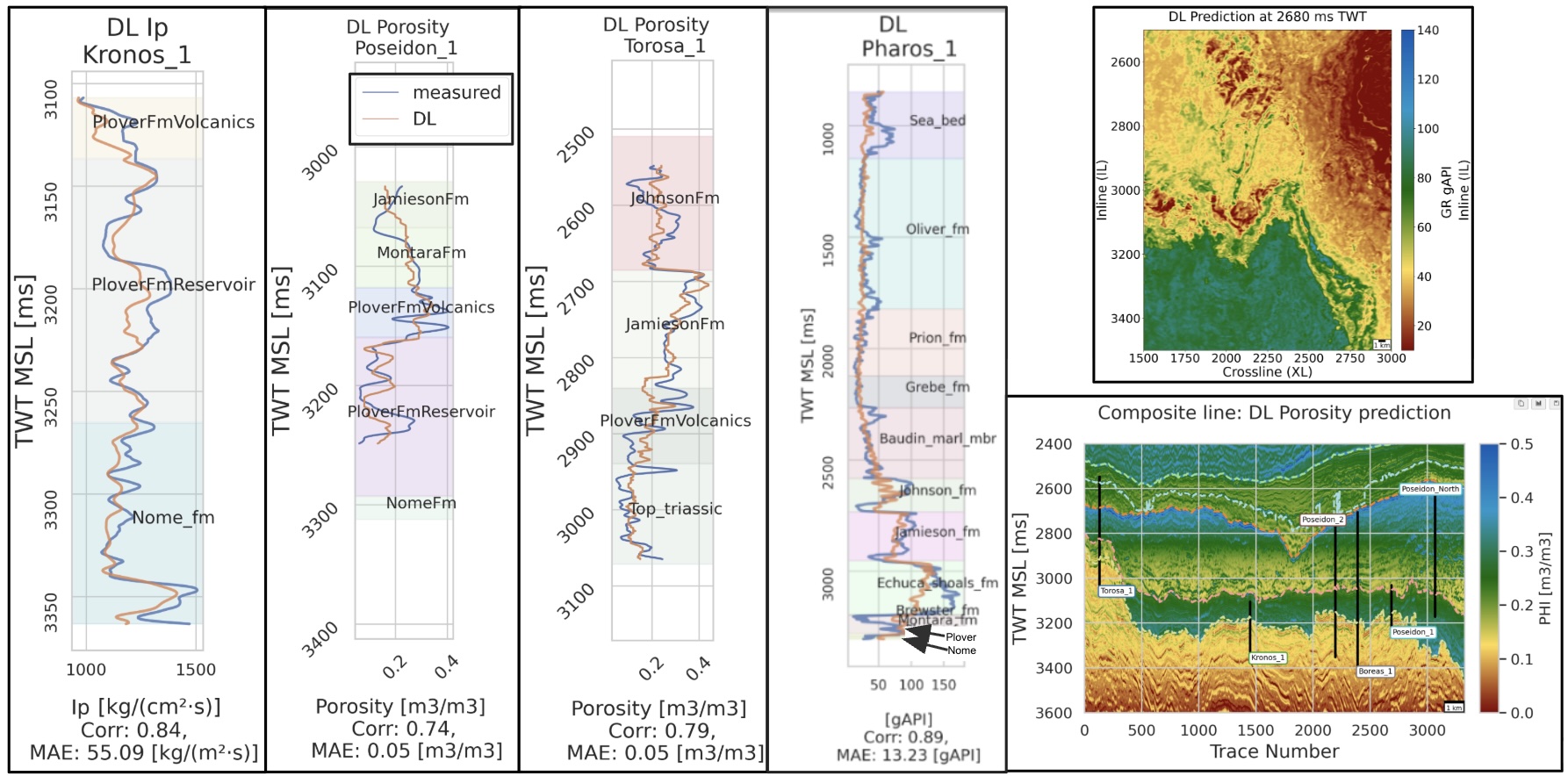
According to the authors, this additional stratigraphic context can significantly improve prediction quality. In blind-well tests, where a well is excluded from model training, the approach achieved correlations exceeding 80 percent. In one key experiment, adding geological information improved the correlation from approximately 70 to 81 percent while halving the prediction error.
The workflow was used to predict acoustic impedance, porosity, and gamma-ray values across the reservoir. The results reproduced key geological trends between wells and identified reservoir features that were less evident in previously published inversion results.
Just as importantly, the workflow delivers results quickly. Once the data have been prepared, training and prediction take less than a minute. The authors note, however, that geological quality control and data conditioning remain essential parts of the process.
Rather than replacing conventional seismic inversion, RagnaRock Geo sees the technology as a complementary tool. Comparing AI predictions with physics-based inversion results may help interpreters identify areas that warrant further investigation and reduce uncertainty in complex reservoirs.
Join us in Lillestrøm on December 2-3 to learn more about how geological knowledge can be combined with artificial intelligence to improve reservoir characterization. The program can be found on the conference website.